
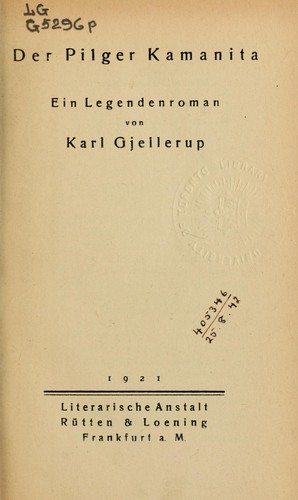
The Pilgrim Kamanita
Karl Gjellerup · 1857–1919 · Denmark
Originally Der Pilger Kamanita (German)
Why it matters
A merchant's son shares a night's shelter with a monk he never recognizes as the Buddha, then pursues his lost beloved across celestial rebirths. A Danish Nobelist's strange, serene Buddhist romance: European fiction's most earnest early journey east.
At a glance
Serene, ornate telling built on Buddhist cosmology that rewards but doesn't require prior knowledge.
Deep dive
What the merchant's son fails to notice about the calm old man sharing his shelter for one night, and how far that blind spot follows him into whatever comes after this life.
Written for readers who have finished the book. No plot recap, and nothing here is safe to read first.
Themes & symbolism
Kamanita spends a whole night in a potter's shed telling a stranger the story of his life: the fortune he built as a trader, the palace he lost to the bandit Angulimala, the great love he can't stop grieving. He tells it well, and he tells it to a robed ascetic he treats as beneath his notice, dismissing the man's quiet teaching about the end of craving as fit for beggars, not for someone who has actually lived. Gjellerup gives the reader one fact Kamanita never gets: this is the Buddha, near the end of his own last journey to Kusinara, and the entire scene runs on the gap between what Kamanita is confiding and whom he thinks he's confiding it to.
That gap is the novel's real subject, not the plot mechanics of the romance with Vasitthi, the merchant's daughter he loved and lost to a rival's lie and years of separation. Kamanita's grief for her is real, and Gjellerup treats it with none of the condescension a lesser Orientalist romance might bring to it, but the novel keeps insisting that a love this total is still a form of craving, still a chain, and the same hunger that makes Kamanita's devotion so moving is exactly what keeps dragging his consciousness onward, refusing to let him rest, long after an ordinary story would have ended.
A Philologist's Buddhism, Not a Tourist's
Gjellerup trained as a theologian and later steeped himself in Pali sources rather than treating Buddhist cosmology as decorative backdrop for a European love story, and it shows in how seriously the novel takes its heaven-realms, its doctrine of rebirth driven by craving, and its refusal to soften the Buddha's teaching into something more palatable to a Christian reader. That seriousness is part of why the Swedish Academy split its 1917 Nobel Prize in Literature between Gjellerup and his countryman Henrik Pontoppidan, citing his varied and rich poetry, a rare case of the prize honoring a European writer for imaginative work built this deliberately on a non-Western religious system rather than importing it as ornament.
The last seal: what actually happens, and why it lands the way it does.
The ending, explained
Furious at hearing his hope of eternal reunion with Vasitthi dismissed as just another craving to be extinguished, Kamanita storms out of the shed and, moments later, is gored to death by a runaway cow, dying with his resentment toward the old ascetic's teaching still fully intact. He's reborn in Sukhavati, a paradise built by craving rather than beyond it, and finds Vasitthi there after ages pass, since she died a genuine disciple of the historical Buddha and had already reached that realm herself. Their long reunion, and her account of how she came to the teaching through Angulimala, the same bandit who once destroyed Kamanita's fortune, finally lets him recognize who shared his fire that last night on earth: the very teacher he'd argued with, offering him the one exit from paradise he'd spent two lifetimes refusing to hear.
Where to go next
 Bjørnstjerne Bjørnson · 1857Synnøve SolbakkenLvl 3Medium pace
 Selma Lagerlöf · 1891Gösta Berling's SagaLvl 6Medium pace
 Knut Hamsun · 1890HungerLvl 5Medium pace
 Sigrid Undset · 1920Kristin LavransdatterLvl 6Slow burn
 Hermann Hesse · 1922SiddharthaLvl 3Medium pace
 Paul Heyse · 1855L'ArrabbiataLvl 2Medium pace