
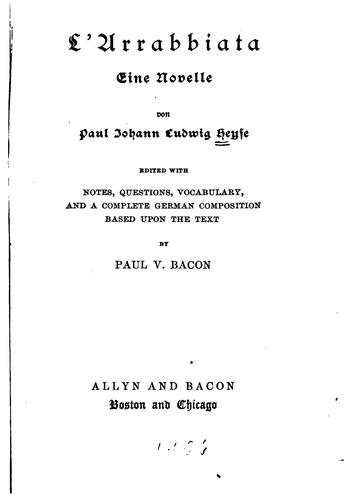
L'Arrabbiata
Paul Heyse · 1830–1914 · Germany
Originally L'Arrabbiata (German)
Why it matters
On a boat between Sorrento and Capri, a fierce fisher-girl nicknamed 'the angry one' refuses the love she most wants. The German novella at its most perfect: a single incandescent image carrying the whole form, exactly as Heyse's falcon theory prescribed.
At a glance
A brief, limpid novella readable in a sitting.
Deep dive
A fierce young fisherwoman known as 'the angry one' has sworn off love entirely, and Heyse builds a whole novella around the one moment on a boat crossing that changes her mind.
Written for readers who have finished the book. No plot recap, and nothing here is safe to read first.
Themes & symbolism
Laurella earns her nickname, l'Arrabbiata, from a village that reads her refusal to be courted as pure temperament rather than the guarded self-protection it actually is, and Heyse spends the novella's opening establishing just how thoroughly she's decided love isn't worth the risk before Antonino, a persistent young sailor, gets her alone on a boat crossing between Sorrento and Capri. The set-up is almost mathematically simple, one woman, one man, one small vessel, one afternoon, which is exactly the kind of concentrated situation Heyse's theory of the novella demanded.
Heyse drew his famous 'falcon theory' of the novella from Boccaccio's tale of a nobleman who serves his beloved a falcon he can no longer afford to feed her any other way, arguing that every good novella needs one unforgettable central image strong enough to carry the whole story's meaning by itself. L'Arrabbiata supplies its own falcon in the crossing's single violent gesture, Laurella drawing a knife on Antonino when his persistence tips into something closer to force, cutting his hand in the struggle, and that wound, not any speech either character makes, is what finally breaks the standoff between them.
The Bay of Naples setting does more than furnish local color: Heyse's sunlit, almost theatrical Italian landscape lets him strip the story down to two people and a boat without the social machinery, chaperones, family negotiations, a German novella of the period would normally require, giving the encounter a directness closer to myth than to the realist marriage plots being written elsewhere in the same decade.
The Falcon Theory, Demonstrated
Heyse wrote L'Arrabbiata at twenty-five as an almost programmatic proof of his own critical theory, and the novella's reputation as German fiction's cleanest example of the form rests on how visibly the theory and the story match: strip away everything but the single knife-wound image, and the whole arc of Laurella's resistance and surrender is legible in it. It's the piece Heyse's Nobel citation half a century later kept circling back to, evidence, the committee's language suggested, of a body of work built on the same disciplined, classical restraint from beginning to end.
The last seal: what actually happens, and why it lands the way it does.
The ending, explained
Horrified at what her own fear has driven her to do, Laurella binds Antonino's cut hand with her own headscarf, the first unguarded, tender gesture she's allowed herself in the whole story, and the act of tending the wound she caused becomes the closest thing the novella offers to a declaration of love neither character will actually speak aloud. Heyse ends the story on that binding rather than on any marriage or promise, trusting the single image, blood drawn, then bandaged by the woman who drew it, to carry a resolution he never has either character explain in words.
Where to go next
 Karl Gjellerup · 1906The Pilgrim KamanitaLvl 5Slow burn
 Theodor Fontane · 1894Effi BriestLvl 4Medium pace
 Colette · 1920ChériLvl 3Medium pace
 Bjørnstjerne Bjørnson · 1857Synnøve SolbakkenLvl 3Medium pace
 Johann Wolfgang von Goethe · 1774The Sorrows of Young WertherLvl 3Medium pace
 Gottfried Keller · 1855Green HenryLvl 5Slow burn