
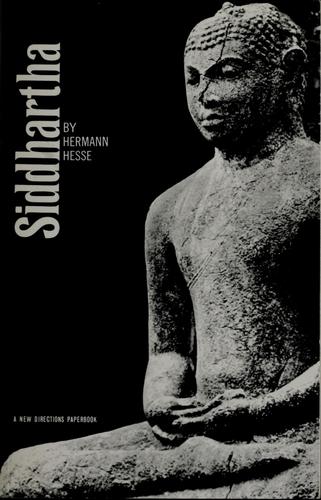
Siddhartha
Hermann Hesse · 1877–1962 · Germany / Switzerland
Originally Siddhartha (German)
Why it matters
A seeker leaves the Buddha's own teaching to find enlightenment through the world, the flesh, and a river. Hesse's spare fable of the search for meaning, and his most beloved book worldwide.
At a glance
Spare, parable-like prose written in deliberately simple, accessible sentences.
Deep dive
A rich man's son tries asceticism, then sensuality, then commerce, then a riverbank — and Hesse structures the whole novel to argue that none of his teachers could have gotten him there faster.
Written for readers who have finished the book. No plot recap, and nothing here is safe to read first.
Themes & symbolism
Siddhartha's refusal to become a disciple of the historical Buddha (Gotama) even while acknowledging his teaching is flawless is the novel's central argument stated outright: wisdom, Hesse insists, cannot be transmitted through doctrine, because the very perfection of Gotama's teaching would make Siddhartha's attainment of it secondhand rather than his own. Every subsequent stage of the novel — the ascetic Samanas, the courtesan Kamala, the merchant Kamaswami, the ferryman Vasudeva — is accordingly not a detour from the path but the path itself, since Hesse's Siddhartha can only earn insight by living every possible wrong turn to its full conclusion rather than being told in advance which turns are wrong.
The river is the novel's controlling symbol, and Hesse builds it in two stages: first as a boundary Siddhartha crosses to leave the spiritual life for the worldly one, and later, after years of wealth and dissipation curdle into disgust and a near-suicide, as the place he returns to and finally learns to simply listen to. Vasudeva teaches him that the river is everywhere at once — its water was once a mountain spring, will become rain, and will be a river again — and that time itself may be an illusion in exactly the same way, past, present, and future coexisting in the water's single simultaneous voice; Siddhartha's enlightenment arrives not as an idea but as the moment he actually hears this rather than merely being told it.
Hesse structures Siddhartha's relationship with his own son as a deliberate, painful echo of his own youth: when the boy Siddhartha fathered with Kamala rejects him and flees back to the city exactly as young Siddhartha once fled his own father's house for the Samanas, Siddhartha is forced to feel, from the other side, the very love-driven desire to protect and possess that he had renounced as an ideal decades earlier — the novel's clearest demonstration that wisdom gained in theory has to be re-earned, at cost, in each new circumstance rather than banked once and for all.
Hesse's Sanskrit Title, German Sentences
Hesse, the son of missionaries who had lived in India, wrote the novel in a deliberately simple, incantatory prose style modeled loosely on Indian religious texts and the cadences of Luther's Bible translation, favoring repetition and parallel clauses over psychological interiority. The approach drew charges of superficial orientalism from some critics, who noted Hesse had never visited India himself and was synthesizing Hindu and Buddhist concepts somewhat freely for his own purposes; the novel's huge mid-century popularity among Western readers, especially during the 1960s counterculture's turn toward Eastern spirituality, cemented both its influence and its status as a Western outsider's stylized vision of enlightenment rather than a text native to either tradition.
The last seal: what actually happens, and why it lands the way it does.
The ending, explained
Old and at peace after his son's departure teaches him a final lesson in the futility of possessive love, Siddhartha stands at the river with his old friend Govinda, still a wandering monk still seeking the teaching he never found, and asks Siddhartha to share his wisdom. Siddhartha, true to the novel's whole argument, insists that wisdom cannot be spoken, only lived and felt — and instead has Govinda kiss his forehead, at which Govinda sees a vision of the entire unified world, every face and form and moment of suffering and joy, flowing together as one simultaneous whole in Siddhartha's countenance, exactly as the river's voices merge into a single Om. Govinda weeps and bows before his old friend; the enlightenment the novel has spent its whole length approaching is rendered, finally, not as a doctrine Siddhartha could have handed over at the start but as a total, wordless perception only available after every one of his lived contradictions has been folded together into unity.
Where to go next
 Hermann Hesse · 1919DemianLvl 5Slow burn
 Hermann Hesse · 1927SteppenwolfLvl 6Medium pace
 Hermann Hesse · 1930Narcissus and GoldmundLvl 4Slow burn
 Hermann Hesse · 1943The Glass Bead GameLvl 7Slow burn
 Thomas Mann · 1912Death in VeniceLvl 6Slow burn
 Johann Wolfgang von Goethe · 1774The Sorrows of Young WertherLvl 3Medium pace