
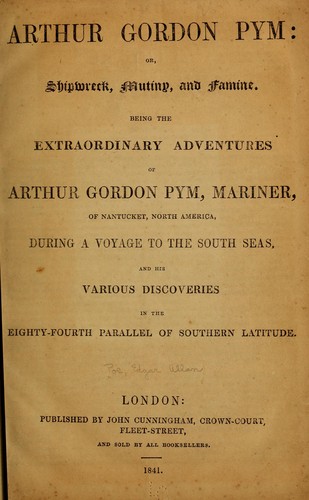
The Narrative of Arthur Gordon Pym
Edgar Allan Poe · 1809–1849 · United States
Why it matters
Poe's only novel sends a stowaway through mutiny, shipwreck, cannibalism, and an increasingly hallucinatory Antarctic voyage. Its ambiguous, unfinished ending influenced everyone from Melville to Borges.
At a glance
Digressive, documentary-style prose with abrupt tonal swings.
Deep dive
Poe's only completed novel starts as a stowaway's boyish sea adventure and by its last pages is sailing somewhere the narrative itself seems to lose the nerve to describe.
Written for readers who have finished the book. No plot recap, and nothing here is safe to read first.
Themes & symbolism
Pym stows away aboard the whaler Grampus with his friend Augustus, survives a bloody mutiny by hiding in the hold, then a countermutiny, then a shipwreck that leaves the hull capsized and the handful of survivors starving on its overturned keel until they draw lots and kill and eat the sailor Parker, an episode Poe narrates with a queasy, procedural calm that scandalized his contemporaries more than any of the novel's later violence. Poe was writing for money and serializing as he went, and the book's lurching structure, boy's-adventure chapters bolted to increasingly hallucinatory ones, shows the seams of that method even as it builds toward something stranger than the survival narrative it started as.
Rescued and carried south aboard the Jane Guy, Pym reaches the island of Tsalal, whose black-toothed, black-skinned inhabitants fear anything white and turn out to be luring the ship's crew into a staged landslide massacre; Pym and the half-Indian sailor Dirk Peters escape by canoe with a captive native, Nu-Nu, drifting into a warmer, milkier sea where fine white ash begins falling from the sky and a towering, shrouded white figure rises directly ahead as the account breaks off. The racial imagery, Blackness coded as danger and deception on Tsalal, an overwhelming whiteness waiting at the pole, has made the ending one of the most argued-over passages in Poe, most influentially by Toni Morrison, who reads it as American racial anxiety pushed all the way to cosmology.
Whiteness at the End of the World
Morrison's reading in Playing in the Dark treats the novel's closing whiteout, ash, mist, a colossal white shape, as the logical endpoint of the black-white terror Poe has been building since Tsalal, American racial dread translated wholesale into a landscape at the bottom of the world where it no longer needs a human antagonist to carry it. Read that way, the unfinished ending isn't a failure of nerve so much as an image with nowhere further to go: Poe has pushed the country's own racial imagination to a literal edge of the map.
The last seal: what actually happens, and why it lands the way it does.
The ending, explained
The narrative stops mid-scene, framed by an editorial note claiming that Pym died before he could supply the final chapters, a hoax layered on top of a book Poe had originally tried to pass off as a true travel account. Nothing about the fate of Pym, Peters, or the canoe is settled: the last image is the plunge toward that immense white figure, and the account simply ends there, refusing the reader the shipwreck narrative's usual return to safety. The abandonment reads, in retrospect, as consistent with the book's method rather than a lapse in it: an escalating structure of literalized dread that Poe seems to have concluded could only be answered by silence, an ending so open it produced sequels from other hands, Jules Verne's included, within decades.
Where to go next
 Edgar Allan Poe · 1839Selected Tales of Mystery and ImaginationLvl 6Fast paced
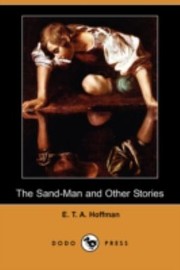 E. T. A. Hoffmann · 1816The SandmanLvl 6Medium pace
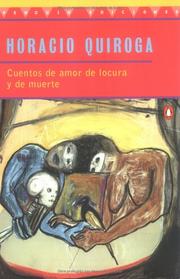 Horacio Quiroga · 1917Stories of Love, Madness, and DeathLvl 4Fast paced
 Nathaniel Hawthorne · 1850The Scarlet LetterLvl 7Slow burn
 Steven Millhauser · 1996Martin Dressler: The Tale of an American DreamerLvl 5Medium pace
 Herman Melville · 1851Moby-DickLvl 8Slow burn