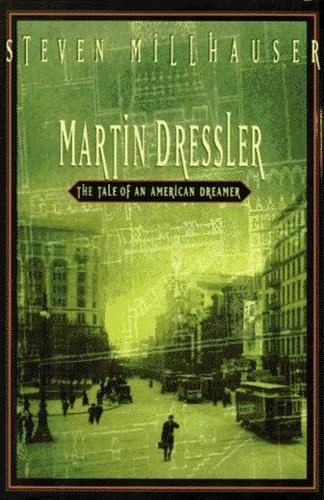
Martin Dressler: The Tale of an American Dreamer
Steven Millhauser · b. 1943 · USA
Why it matters
A tobacconist's son rises from bellboy to the builder of ever more fantastical hotels, his American ambition escalating past all reasonable limit into something closer to hallucination. Millhauser's Pulitzer winner renders capitalist dreaming as both fairy tale and cautionary fever dream.
At a glance
Dreamlike escalation and meticulous descriptive detail slow the pace despite clear, controlled prose.
Deep dive
A hotel that stops being a hotel and becomes an entire enclosed world, read here as the American Dream's logical destination rather than its betrayal.
Written for readers who have finished the book. No plot recap, and nothing here is safe to read first.
Themes & symbolism
Martin's hotels grow more fantastical with each venture, culminating in the Grand Cosmo, a hotel that contains simulated forests, entire fabricated environments, and eventually something closer to a whole enclosed alternate reality than a place to sleep. Millhauser isn't satirizing Gilded Age ambition from a safe ironic distance — he's taking the internal logic of American enterprise completely seriously and following it to its natural, absurd extreme: not meeting demand but manufacturing an entire world a guest need never leave. Martin's genius and his delusion are the same faculty operating at different scales, which is why the novel refuses to resolve into simple moral lesson about hubris.
Martin marries the passive, dreamy Caroline while remaining genuinely drawn to her more vital, capable sister Emmeline, and the marriage — largely sexless, more a cohabitation of two people who never quite meet — mirrors his business instincts exactly. Caroline is an empty vessel he can fill with his own projections, the same relationship he has to his hotels; Emmeline, who has actual presence and will, is the harder, realer thing he keeps choosing not to reach for. His preference for the manufactured ideal over the full human alternative runs through both plots identically.
Turn-of-the-Century New York as Prophecy
The novel doubles as a history of the era's actual hotel-building, department-store, and amusement-park booms, and Millhauser's lifelong fascination with dioramas, automata, and total simulated environments finds its fullest expression in the Grand Cosmo — a direct ancestor of the twentieth-century shopping mall and theme park. Later readers have noted how precisely Martin's arc anticipates a recognizable modern type: the visionary founder whose confidence in his own imagination outruns every signal that the public isn't actually asking for what he's building, a pattern the novel diagnosed a century before it became a business-press cliché.
Millhauser's prose itself performs the novel's obsession with total, obsessive craft — long, meticulous, cumulative sentences that inventory a building or a scheme down to its last fitting, the same acquisitive thoroughness Martin brings to construction. The style never breaks into irony or authorial judgment even at Martin's most grandiose, which is precisely how Millhauser keeps the book from curdling into simple satire; the prose believes in the dream exactly as fully as Martin does, right up until the dream stops paying for itself.
The last seal: what actually happens, and why it lands the way it does.
The ending, explained
The Grand Cosmo is panned by critics and fails commercially, and Martin, rather than fighting to save it, lets its creditors take his other properties too, watching his empire dissolve with something closer to acceptance than devastation. The ending refuses tragedy's usual shape: Martin doesn't experience the collapse as ruin so much as a strange completion, as if having built the impossible thing mattered more than its surviving. He's last seen simply watching, from outside, oddly at rest — the ambition itself, not its durability, was always the actual point.