
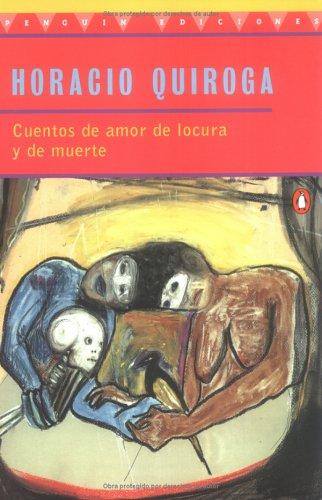
Stories of Love, Madness, and Death
Horacio Quiroga · 1878–1937 · Uruguay
Originally Cuentos de amor, de locura y de muerte (Spanish)
Why it matters
Snakebites, fevers, and casual catastrophe stalk the Argentine rainforest in stories of exacting, Poe-influenced precision. One of Spanish-language fiction's great short-story collections.
At a glance
Tight, plainly told tales in the Poe tradition of mounting, legible dread.
Deep dive
Snakebite, a starving pillow-dwelling parasite, and a father who can't stop reenacting a chicken's slaughter: how Quiroga turns the Misiones jungle into a laboratory for sudden, clinical death.
Written for readers who have finished the book. No plot recap, and nothing here is safe to read first.
Themes & symbolism
Quiroga sets most of these stories in the Misiones jungle where he'd cleared his own farm by hand, and the setting is never romantic backdrop, it's an indifferent physical system that kills through simple, traceable causes: a snakebite, a fall onto a blade, an unsupervised afternoon. 'The Decapitated Chicken' is the collection's cruelest demonstration. Four brothers, left mentally disabled by childhood meningitis, watch their father kill hens for Sunday dinner with a casual competence he never shows them, and their parents, exhausted and quietly ashamed of them, lavish what affection remains on their one healthy daughter, Bertita. Left alone with her one afternoon, the brothers repeat the only decisive, purposeful act they've ever seen a family member perform. Quiroga narrates the violence with the same flat competence the father used on the hens, refusing either horror-movie suspense or moral commentary, because the story's real accusation is aimed at the parents' years of neglect, not at the boys.
'The Feather Pillow' works the same clinical method on a domestic scale: Alicia, newly married to the cold, undemonstrative Jordán, wastes away from an unnamed illness that leaves doctors baffled, and Quiroga saves the story's one image for the final paragraph rather than building toward it, a monstrous parasite discovered living inside her pillow, feeding on her nightly. The reveal doesn't function as a twist for its own sake. It's the story's argument made literal: a marriage offering no real intimacy has been quietly draining her the entire time, and the creature is simply the wound made physical enough to autopsy. 'Drifting' and 'The Dead Man' strip away even that much symbolism, following a snakebitten man's arithmetic of survival down a river and a farmer's uncomprehending final minutes after an accidental fall onto his own machete, in real time, with the rest of the world going on around each man exactly as if nothing were happening. Death, across all four stories, is never dramatic. It's procedural.
A Life That Kept Supplying Its Own Material
Quiroga's biography reads like a grim rough draft for his fiction: his father died in a hunting accident when Quiroga was an infant, his stepfather shot himself in front of him as a teenager, he accidentally killed his close friend Federico Ferrando while inspecting a pistol he believed was unloaded, and his first wife took her own life after years of isolation on his jungle farm. Decades later, facing terminal cancer, Quiroga ended his own life with cyanide. None of that turns these stories into disguised memoir exactly, but it explains the register: a writer this repeatedly and directly acquainted with sudden, physical death has no need to dramatize it further than plainly reporting how it happens.
The Decalogue and the Discipline of One Effect
Quiroga wrote a widely circulated manifesto, his 'Decalogue of the Perfect Short Story Writer,' insisting a story should serve a single unified effect from its first line, a rule borrowed directly from Poe and enforced with real discipline across this collection: no story here wastes a paragraph on incident that doesn't serve its ending. 'The Feather Pillow' withholds its one image until the final lines precisely because Quiroga believed a story should function like a struck match, all its force arriving at once, and that economy is what still makes these hundred-year-old case studies in sudden death feel engineered rather than merely grim.
Where to go next
 Silvina Ocampo · 1959Thus Were Their FacesLvl 5Fast paced
 Edgar Allan Poe · 1839Selected Tales of Mystery and ImaginationLvl 6Fast paced
 Mariano Azuela · 1915The UnderdogsLvl 4Fast paced
 Rómulo Gallegos · 1929Doña BárbaraLvl 4Medium pace
 Ricardo Güiraldes · 1926Don Segundo SombraLvl 5Medium pace
 Jorge Luis Borges · 1944FiccionesLvl 7Slow burn