
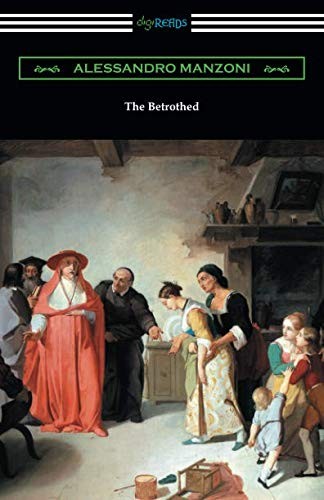
The Betrothed
Alessandro Manzoni · 1785–1873 · Italy
Originally I promessi sposi (Italian)
Why it matters
Two peasant lovers are separated by a tyrannical lord and swept through plague, famine, and war in seventeenth-century Lombardy. The founding classic of the Italian novel and, in its revised prose, a template for the modern Italian language itself.
At a glance
Long, digressive historical narration with extended essayistic detours.
Deep dive
How a two-line threat from a coward's mouth sets off a chain that only a plague can untangle — and what Manzoni was really doing to the Italian language while he wrote it.
Written for readers who have finished the book. No plot recap, and nothing here is safe to read first.
Themes & symbolism
Everything downstream of the novel's opening flows from one man's failure of nerve: Don Abbondio, threatened by Don Rodrigo's bravoes, refuses to marry Renzo and Lucia, and his cowardice — not villainy, just ordinary self-preservation — does more damage across the book than Don Rodrigo's actual malice, because it's endlessly renewable in a way outright evil isn't. Manzoni's Catholic providentialism runs underneath every reversal: the plague that finally kills Don Rodrigo and clears Renzo and Lucia's path isn't narrative convenience so much as the novel's thesis made literal, that suffering arrives indiscriminately but God's order reasserts itself through it, humbling the powerful (Don Rodrigo dies raving, alone, unrecognized) as readily as the powerless.
The Unnamed's (l'Innominato) conversion — a hardened, feared warlord who abducts Lucia on Don Rodrigo's behalf and then, confronted by her prayer-filled terror in his own castle, is broken by a single sleepless night into repentance — is the novel's clearest statement that grace operates on the guilty as readily as the innocent, redeeming the plot's most frightening figure rather than simply punishing him. Cardinal Federigo Borromeo, tending plague victims in Milan while the aristocracy flees, stands as the novel's model of authority used rightly, the deliberate opposite number to Don Abbondio's authority used to duck responsibility.
Rinsing the Laundry in the Arno
Manzoni's first draft, Fermo e Lucia, was written in a Lombard-inflected literary Italian nobody outside educated northern circles actually spoke. He spent years afterward — by his own famous phrase, "sciacquare i panni in Arno," rinsing the laundry in the Arno — revising the entire novel into the Florentine Tuscan of Dante and Boccaccio, treating prose style as a nation-building project rather than an aesthetic preference. Published decades before Italian unification, The Betrothed effectively supplied the unified country with a shared literary language before it had a shared government to go with it.
The Plague as Documentary History
Manzoni researched Milan's actual 1630 plague from contemporary chronicles, and the novel's account — mass graves, the untori hysteria in which panicked mobs lynched supposed plague-spreaders on the flimsiest suspicion, the breakdown of law alongside the survival of ordinary decency in figures like Fra Cristoforo — reads closer to historical reportage than romantic backdrop. Manzoni later published a companion essay, Storia della colonna infame, examining a real wrongful trial and execution from the same plague year, underlining that the novel's plague sequence was an indictment of mob justice as much as a natural disaster.
The last seal: what actually happens, and why it lands the way it does.
The ending, explained
Lucia, who vowed to the Madonna during her captivity that she'd renounce marriage if spared, is released from that vow by Fra Cristoforo's absolution once Don Rodrigo — dying of plague in the lazaretto, abandoned and unrecognized — is visited by Renzo, who forgives him rather than settling the old score. Renzo and Lucia finally marry and relocate to escape a village too saturated with memory to feel like home again. The novel closes with its narrator distilling a moral, the "sugo della storia": that misfortunes are frequently self-inflicted, but that even undeserved suffering, met with faith rather than rebellion, resolves into something bearable. It's a deliberately modest landing for an epic-scaled ordeal — no triumph, just survival dignified by trust.
Where to go next
 Giovanni Verga · 1881The House by the Medlar TreeLvl 6Slow burn
 Luigi Pirandello · 1904The Late Mattia PascalLvl 5Medium pace
 Grazia Deledda · 1913Reeds in the WindLvl 4Medium pace
 Heinrich von Kleist · 1810Michael KohlhaasLvl 6Fast paced
 Ann Radcliffe · 1794The Mysteries of UdolphoLvl 5Slow burn
 Walter Scott · 1814WaverleyLvl 6Medium pace