
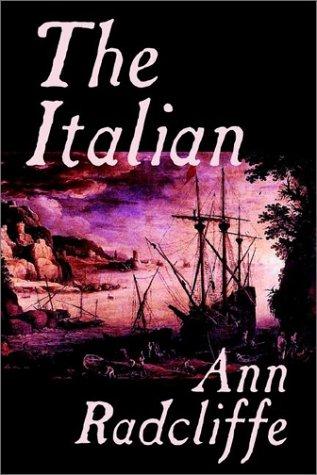
The Italian
Ann Radcliffe · 1764–1823 · England
Why it matters
A monk's sinister plot to force apart two lovers unravels through Inquisition dungeons and Apennine convents. Radcliffe's darkest, tautest gothic tightens the machinery of terror she perfected in Udolpho.
At a glance
Long period sentences, but a tightly plotted gothic thriller compared to her earlier novels.
Deep dive
A Dominican confessor is hired to remove the poor orphan a marchesa considers unfit for her son, and the closer he gets to finishing the job, the more the girl's family history starts to look like his own.
Written for readers who have finished the book. No plot recap, and nothing here is safe to read first.
Themes & symbolism
Schedoni, the Marchesa di Vivaldi's confessor, is the character The Italian actually belongs to: hired to have Ellena di Rosalba killed so she can never marry into the Vivaldi family, he raises the dagger over her sleeping body in a lonely coastal house and stops only because a miniature portrait around her neck convinces him, wrongly, that she is his own daughter. Radcliffe gives her villain a motive that outruns simple wickedness, ambition, guilt, and a self-interest so total that even his one act of mercy is really self-preservation dressed as fatherhood, and the result is a gothic antagonist with more interior life than the young lovers, Vincentio di Vivaldi and Ellena herself, whose story he keeps hijacking.
The Roman Inquisition, which eventually tries Schedoni for an older crime, gives Radcliffe her clearest image of institutional power turned instrument of private grudge: confession, meant to unburden a conscience, becomes throughout the novel a tool the powerful use to extract what they need from the weak, first the Marchesa working through Schedoni to have Ellena disposed of, then the Inquisition itself, less interested in truth than procedure. True to Radcliffe's method across her fiction, every apparently supernatural terror, the ghostly figure that stalks Vivaldi through the ruined Paluzzi chapel, the voice that seems to accuse him from nowhere, resolves into a rational, human cause: her gothic frightens without ever asking the reader to believe in anything but human cruelty.
Answering Lewis's Monk
Radcliffe wrote The Italian in direct response to Matthew Lewis's The Monk, published the previous year and widely read as a scandal for its rapist-murderer friar and its explicit supernatural machinery. Schedoni is Radcliffe's answer: a corrupt cleric drawn with genuine psychological shading rather than lurid spectacle, his crimes explained by pride and calculation rather than diabolic possession. The rewrite worked as a statement of principle as much as plot, that terror earns more by what it withholds than by what it shows, and it became the fullest statement of the 'explained supernatural' technique Radcliffe had been developing since The Mysteries of Udolpho.
The last seal: what actually happens, and why it lands the way it does.
The ending, explained
The Inquisition's investigation uncovers who Schedoni really is: not a lifelong monk but Count Ferrando, who years earlier murdered his own brother to seize his title and, he believed, his brother's widow, only to learn too late that the woman he actually married was Ellena's aunt rather than her mother, which makes Ellena his niece rather than the daughter he spared her for. Confronted with this and with Nicola di Zampari, the accomplice hired for the original assassination attempt and now testifying against him, Schedoni takes poison rather than face execution, and dies in his cell still withholding as much as he confesses. With Schedoni gone and the Marchesa's scheme exposed, the obstacles between Vivaldi and Ellena dissolve almost administratively; they marry, and Radcliffe closes the novel less on their happiness than on the vacancy Schedoni leaves, a villain whose motives the book has spent four hundred pages complicating, disposed of in a single private, unwitnessed act.
Where to go next
 Ann Radcliffe · 1794The Mysteries of UdolphoLvl 5Slow burn
 Walter Scott · 1814WaverleyLvl 6Medium pace
 Johann Wolfgang von Goethe · 1774The Sorrows of Young WertherLvl 3Medium pace
 Emily Brontë · 1847Wuthering HeightsLvl 6Medium pace
 E. T. A. Hoffmann · 1816The SandmanLvl 6Medium pace
 Alessandro Manzoni · 1827The BetrothedLvl 5Medium pace