
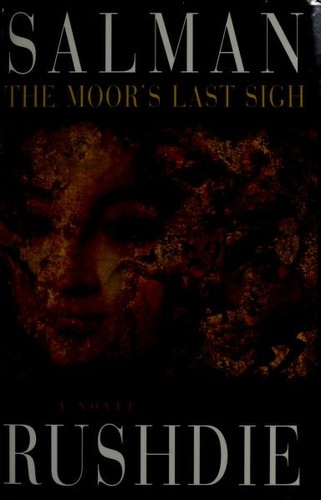
The Moor's Last Sigh
Salman Rushdie · b. 1947 · India / England
Why it matters
The last scion of a Cochin spice-trading dynasty, Christian, Jewish, Hindu, and Muslim blood tangled in one family tree, races through a wrecked, accelerated lifetime to outrun his own aging. Rushdie's most maximalist portrait of India's plural, embattled inheritance.
At a glance
A vast family tree, compressed lifespan, and dense wordplay demand close attention across generations.
Deep dive
A Bombay family with alleged roots in both Vasco da Gama's spice trade and the last Moorish king of Granada spends four generations proving that Rushdie can fit five hundred years of history into one bloodline without it ever feeling like homework.
Written for readers who have finished the book. No plot recap, and nothing here is safe to read first.
Themes & symbolism
Moraes Zogoiby, the half-Jewish, half-Christian narrator who ages at twice the normal rate and carries a deformed hand he calls his hammer, traces his family back through the da Gamas, prosperous Cochin spice traders, and the Zogoibys, a poor Jewish family claiming descent from the last Sultan of Granada, and Rushdie uses the improbable double lineage to argue that Indian identity was always this mixed underneath, however hard later nationalism worked to sort it into single categories.
Aurora Zogoiby, Moraes's painter mother, dominates the novel's middle section as a matriarch whose art and whose cruelty are barely distinguishable, staging elaborate, half-mocking scenes of family history on canvas while disowning her own son in public for marrying outside the family's approval, so that the novel's real violence is domestic long before Bombay's actual communal riots arrive in its later chapters to make the metaphor literal.
Vasco Miranda, Aurora's spurned former protege and lover, gives the novel its clearest villain precisely because his grievance is petty rather than ideological, a failed artist's resentment of a woman who outgrew him, and Rushdie lets that small, human motive curdle into a violence that echoes the larger communal hatreds tearing through the book's Bombay without ever losing its personal, almost embarrassing pettiness.
Aurora's Paintings as a Second History of India
Aurora's Mooristan series, which reimagines a syncretic, invented India where Arab, Jewish, Hindu, and Christian architecture and myth overlap on the same canvas, gives Rushdie a visual counterpart to the novel's own layered prose, and Vasco's obsessive, resentful imitation of her work turns art forgery into the book's clearest metaphor for communalism, the desperate insistence that there is only one true version of a mixed inheritance.
A Family Tree Rooted in 1492
By tracing the Zogoiby line back to a supposed bloodline connection with Boabdil, the last Muslim sultan of Granada, exiled the same year Columbus sailed and Spain expelled its Jews, Rushdie yokes Moraes's family collapse to the end of Al-Andalus's centuries of religious coexistence, using 1492 as a historical rhyme for the communal violence tearing through Bombay in the novel's own contemporary chapters.
The last seal: what actually happens, and why it lands the way it does.
The ending, explained
Vasco Miranda imprisons Moraes in his fortress at Benengeli in southern Spain and forces him to write his life story at gunpoint, in installments, Scheherazade-style, keeping him alive only as long as the telling holds his interest, this narration being the very text the reader has been following. Locked in the same tower is Aoi Ue, a Japanese conservator Vasco has kidnapped to strip away his own overpainting on Aurora's last canvas and reveal the original portrait underneath. Moraes eventually escapes into the Andalusian dark, leaving pages of his manuscript nailed to trees and gateposts behind him like a trail, a fugitive nailing not theses but his own family's history to the landscape of the country his ancestors were expelled from five centuries earlier. He ends the book alone on a hillside, hoping only to fall asleep and wake into a better time.
Where to go next
 Salman Rushdie · 1981Midnight's ChildrenLvl 8Medium pace
 Salman Rushdie · 1983ShameLvl 7Medium pace
 Salman Rushdie · 1988The Satanic VersesLvl 9Slow burn
 Salman Rushdie · 1990Haroun and the Sea of StoriesLvl 2Fast paced
 Arundhati Roy · 1997The God of Small ThingsLvl 7Slow burn
 Gabriel García Márquez · 1967One Hundred Years of SolitudeLvl 6Medium pace