
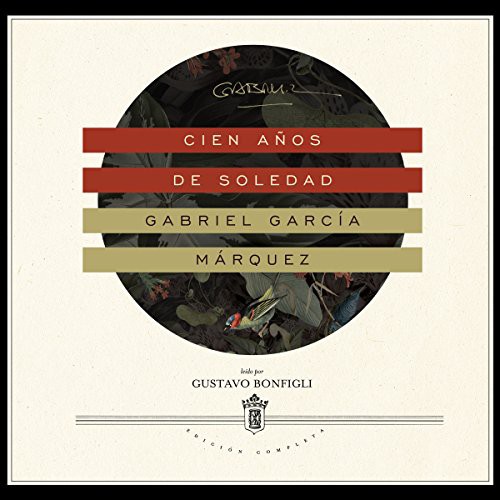
One Hundred Years of Solitude
Gabriel García Márquez · 1927–2014 · Colombia
Originally Cien años de soledad (Spanish) · translated by Gregory Rabassa
Why it matters
Seven generations of Buendías in Macondo, where ascensions and massacres share one calm voice. The rare masterpiece that is also a planetary bestseller: it remade world literature's map and gave a continent its epic.
At a glance
Plainly told sentence by sentence, but seven generations of repeating names strain tracking.
Deep dive
Why the same handful of names keep recurring across seven generations, and what the novel is doing when it makes a massacre officially vanish.
Written for readers who have finished the book. No plot recap, and nothing here is safe to read first.
Themes & symbolism
The naming pattern is the argument, not decoration: every José Arcadio is impulsive and physical, every Aureliano cerebral and solitary, as if the family were a genetic sentence being served out over a century. Úrsula spends the book dreading a literal version of that sentence — the pig's tail she was warned would appear if cousins kept marrying cousins — and the novel's cruelest joke is that the curse she polices for a hundred years is finally delivered by the one pairing she never saw coming, Aureliano Babilonia and his aunt Amaranta Úrsula, who fall in love without knowing what they are to each other.
Solitude here isn't loneliness so much as a structural inability to connect action to consequence: Colonel Aureliano Buendía starts thirty-two wars and loses all of them, less from conviction than from an addiction to fighting itself; Remedios the Beauty is so untouched by ordinary understanding that she ascends bodily into the sky while folding laundry, too pure for the plot to hold onto her. Underneath the wonders sits a documented atrocity — the 1928 massacre of striking banana workers — which the novel restages and then has the entire town gaslight itself into forgetting, a rehearsal for the amnesia that finally swallows Macondo whole.
The Banana Massacre and the Politics of Forgetting
García Márquez lifts the massacre almost intact from the real 1928 killing of United Fruit Company strikers at Ciénaga, Colombia — an event the government of the day officially denied ever happened. In the novel, José Arcadio Segundo survives by being thrown from the death train, wakes to find the corpses gone and the entire town, under military occupation and gentle daily persuasion, insisting nothing occurred. He alone remembers; everyone else adopts the official story. The four years, eleven months, and two days of rain that follow read as biblical cleansing, but they're also doing the government's work for it, washing away whatever evidence the massacre left behind.
A Genealogy of Names
Úrsula, the family's longest-lived member and its closest thing to a conscience, tries early on to break the naming habit and fails — the household keeps reproducing José Arcadios and Aurelianos the way it keeps reproducing their fates, because in Macondo character is inherited before it's chosen. Read as a chart rather than a plot, the family tree is the novel's real structural spine: a closed system generating the same handful of outcomes until Melquíades's prophecy, and the birth of a child with a tail, finally closes it for good.
The last seal: what actually happens, and why it lands the way it does.
The ending, explained
Aureliano Babilonia finally deciphers Melquíades's parchments — written a century earlier in coded Sanskrit — in the same hour that Amaranta Úrsula dies giving birth to their son, who is born with the pig's tail Úrsula spent her whole life trying to prevent. Ants carry the infant away. Reading on, Aureliano realizes the parchments are not a prophecy but a transcript: Melquíades wrote the family's entire history in advance, and Aureliano is reading the account of his own reading of it in the very instant he lives it, so the manuscript and the novel converge into a single closing object. A biblical wind rises and erases Macondo as he reaches the last line, because, the parchment tells him, races condemned to a hundred years of solitude do not get a second chance on earth.
Where to go next
 Gabriel García Márquez · 1961No One Writes to the ColonelLvl 3Medium pace
 Gabriel García Márquez · 1975The Autumn of the PatriarchLvl 9Slow burn
 Gabriel García Márquez · 1981Chronicle of a Death ForetoldLvl 5Fast paced
 Gabriel García Márquez · 1985Love in the Time of CholeraLvl 4Medium pace
 Gabriel García Márquez · 1994Of Love and Other DemonsLvl 5Medium pace
 Juan Rulfo · 1955Pedro PáramoLvl 7Slow burn