
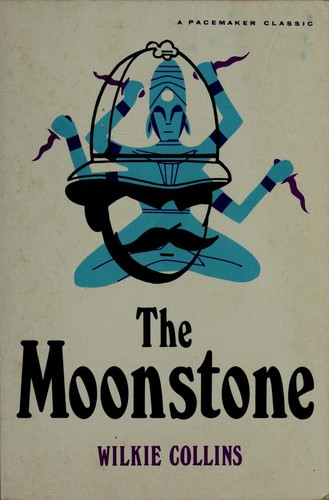
The Moonstone
Wilkie Collins · 1824–1889 · England
Why it matters
A cursed Indian diamond vanishes from an English country house, and multiple unreliable narrators piece together what happened. Often called the first great English detective novel, complete with a brilliant, eccentric investigator.
At a glance
Layered testimonies from unreliable narrators reward close attention.
Deep dive
A cursed Indian diamond vanishes from a locked English country house on the night it's given to an heiress, and the novel that invented the modern detective story spends a dozen conflicting narrators finding out who moved it, and why the most obvious suspect didn't.
Written for readers who have finished the book. No plot recap, and nothing here is safe to read first.
Themes & symbolism
The novel's prologue, a first-person account of the storming of Seringapatam in 1799, establishes the Moonstone as loot before it is ever a gift: John Herncastle kills its Hindu guardians to take it, and the curse the dying priest pronounces on whoever possesses it unjustly is less supernatural machinery than Collins's way of keeping the theft itself in view throughout what follows. The three disguised Brahmins who track the diamond across decades to Yorkshire are the novel's return of the colonial repressed, figures the English household reads as sinister foreign mystics when they are, in the book's own moral arithmetic, the diamond's rightful claimants pursuing stolen property.
Collins builds the mystery entirely out of competing, partial witnesses, the literal-minded steward Gabriel Betteredge, the pious and insufferable Miss Clack, the lawyer Bruff, Franklin Blake himself, each supplying a written account for reasons the frame narrative makes explicit, and the gaps between what one narrator notices and what another does becomes the novel's actual detective method. The device that would define the genre, Sergeant Cuff's outside investigation, matters less to the plot's resolution than the household's own selective blindness: everyone closest to the theft has a reason, vanity, propriety, love, not to see what's directly in front of them.
Opium and the Unwilling Thief
The solution Collins builds toward, that Franklin Blake stole the diamond himself while sleepwalking under an opium dose he never knowingly took, lets the novel stage a theft with no villain inside it: Ezra Jennings, the outcast doctor addicted to opium for his own terminal illness, reconstructs the crime by dosing Blake again under controlled conditions and watching him reenact it. Collins, himself dependent on laudanum while writing the novel for his own chronic pain, uses Jennings's marginalized status, his mixed race and addiction make him a pariah in Yorkshire society, to place the book's clearest thinking in its least trusted narrator.
Rosanna Spearman's Unread Letter
Rosanna, a servant with a criminal past and a hopeless love for Blake she knows can never be returned, hides evidence that could clear him without understanding what actually happened, then drowns herself in the Shivering Sand, the quicksand she has spent the novel treating as a private confidant. Her note, addressed to Blake and left unread by him for most of the book, is Collins's bleakest joke on the whole detective-fiction apparatus: the person who came closest to solving the case was never in a position, socially or narratively, to be listened to.
The last seal: what actually happens, and why it lands the way it does.
The ending, explained
Godfrey Ablewhite, the philanthropist fiance everyone in the novel trusts completely, turns out to be the diamond's actual thief: Blake, drugged and sleepwalking, took the Moonstone from Rachel's cabinet only to hand it, still in his opium haze, to Ablewhite for safekeeping, and Ablewhite, secretly ruined by debt and a hidden mistress, kept it rather than returning it. He disguises himself as one of the three Indian agents to pawn the stone in London, and the real Brahmins, who have been watching all along, catch him in that disguise and kill him to reclaim it, leaving his body found dressed as the very figures the novel spent its length treating as threats. The diamond returns to India and the shrine it was stolen from, restored to its guardians in the novel's closing image, while the English household that spent a year tearing itself apart over it is left with nothing but the ordinary marriage, Blake and Rachel's, that the theft nearly prevented.
Where to go next
 Wilkie Collins · 1859The Woman in WhiteLvl 4Fast paced
 Charles Dickens · 1861Great ExpectationsLvl 4Medium pace
 Charlotte Brontë · 1847Jane EyreLvl 4Medium pace
 Emily Brontë · 1847Wuthering HeightsLvl 6Medium pace
 Bram Stoker · 1897DraculaLvl 4Fast paced
 Anthony Trollope · 1857Barchester TowersLvl 4Medium pace