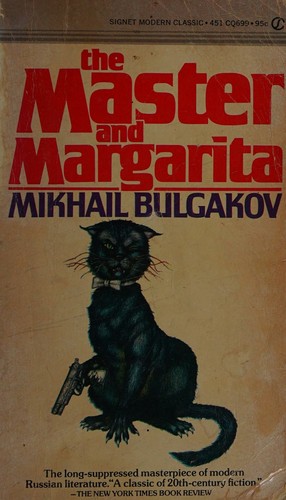
The Master and Margarita
Mikhail Bulgakov · 1891–1940 · Ukraine / Russia
Originally Master i Margarita (Russian)
Why it matters
The Devil arrives in atheist Moscow with a gun-toting cat; Pilate interrogates Yeshua; a witch flies over the city. Written in secret, published a generation late, and instantly the best-loved Russian novel of its century. 'Manuscripts don't burn.'
At a glance
Interleaved Moscow and Jerusalem timelines and dense satirical allusion complicate a wild farce.
Deep dive
How a novel about the Devil vacationing in Stalin's Moscow doubles as a smuggled retrial of Pontius Pilate — and what 'manuscripts don't burn' turns out to mean literally, not just as a slogan.
Written for readers who have finished the book. No plot recap, and nothing here is safe to read first.
Themes & symbolism
Woland arrives in officially atheist Moscow not to tempt anyone but to audit it, and what he exposes is greed, careerism, and bad faith rather than doubt — the satirical target throughout is the literary bureaucracy of MASSOLIT, the housing shortage, the informants and functionaries who've replaced conscience with paperwork. The novel's most quoted line, 'manuscripts don't burn,' isn't just a slogan about art's survival — it's a direct rebuttal staged inside the plot, since the Master has already burned his own manuscript about Pontius Pilate in despair, and Woland produces it whole and undamaged, literalizing the claim in front of him.
That buried manuscript is itself the novel's other half: Pilate's interrogation of Yeshua Ha-Notsri, and the argument, spoken outright, that cowardice is 'the most terrible of vices.' Pilate's actual crime isn't condemning an innocent man — it's being too afraid of Rome, and of his own career, to save someone he already believes is right. He pays for it with two thousand years of sleepless, unaging guilt, waiting under the same moon for a resolution he can't grant himself.
Written in the Drawer
Bulgakov worked on the novel in secret from 1928 until his death in 1940, revising it through a dozen versions and, in 1930, actually burning an early draft in despair — the same act he later gives to the Master, turning the book's central metaphor into autobiography. He never saw it published. His widow, Elena, preserved and retyped the manuscript for over two decades before a heavily censored version finally ran in a Moscow magazine in 1966–67, with the uncensored text circulating underground before reaching print. It arrived a generation late and was embraced instantly, satire of Stalinist Moscow smuggled past the censors disguised as fantasy. Margarita's own arc — agreeing to become a witch and host Satan's midnight ball, a parade of history's poisoners and murderers, purely for a chance to win the Master back — turns her into the novel's most active character, and her flight naked over Moscow on a broomstick, trashing a literary critic's apartment on the way, is Bulgakov's most gleeful revenge fantasy against the bureaucrats who'd suppressed his own work.
The last seal: what actually happens, and why it lands the way it does.
The ending, explained
As Woland's retinue prepares to leave Moscow, Matthew Levi arrives as an emissary from Yeshua, asking that the Master and Margarita be granted rest. They're refused 'light' — reserved, it's implied, for those of stronger faith than a man who burned his own book in despair — and granted 'peace' instead: an eternal home imagined as a candlelit cottage among cherry trees, with old books and Schubert. In the parallel Pilate narrative, the freed Master calls out across two thousand years, 'You're free! He is waiting for you!', and Pilate finally walks up a moonbeam path to reconcile with Yeshua, his guilt lifted. Moscow itself resets — the chaos gets explained away by the authorities as mass hypnosis and coincidence, and only the reader is left holding the true account.