
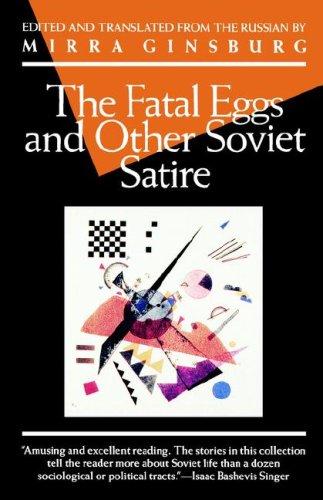
The Fatal Eggs
Mikhail Bulgakov · 1891–1940 · Ukraine / Russia
Originally Rokovye Yaitsa (Russian)
Why it matters
A Moscow zoologist's growth ray, meant to save Soviet farming, is mixed up with the wrong eggs and hatches monstrous reptiles that overrun the countryside. Bulgakov's earliest major satire turns scientific utopianism into slapstick catastrophe.
At a glance
A short, fast-moving satirical novella with a clear science-gone-wrong plot.
Deep dive
A Moscow professor discovers a ray that accelerates growth in any organism, the state seizes on it to fix a national chicken shortage, and a clerical mix-up in egg crates is all it takes to turn the fix into a catastrophe.
Written for readers who have finished the book. No plot recap, and nothing here is safe to read first.
Themes & symbolism
Professor Persikov finds the red ray by accident, peering through a faulty microscope lens and noticing that the light itself makes amoebas grow and multiply at an obscene rate. He wants years to study it quietly, the way he has studied every other slow discovery of his long academic life. The state has other plans: a mysterious plague has wiped out the country's chickens, and a blustering opportunist named Rokk gets a Kremlin mandate to use the ray on an experimental farm to breed replacements fast, whatever Persikov's objections. Bulgakov's satire is aimed less at the ray itself than at the chain of command that snatches a fragile discovery out of a scientist's hands before he understands what it does, and the color he chooses for it, red, is not subtle: the same shade the state is currently painting over every failure it needs disguised as a plan.
The catastrophe turns on the pettiest possible error: Persikov's institute, mid-plague, has taken delivery of foreign snake, ostrich, and crocodile eggs for unrelated research, while Rokk's farm is waiting on a shipment of ordinary chicken eggs. The crates get switched by a harried clerk who has no idea what either shipment is for. Rokk irradiates the reptile eggs, and the farm outside Moscow hatches giant snakes and crocodiles that start moving on the capital while the government scrambles to explain, then conceal, then finally admit what its own bureaucracy has done, issuing calm bulletins about a menace that is by then visibly devouring whole villages. Only a freak August frost, arriving with no more logic than the mix-up that caused the disaster, kills the reptiles before they reach the city, sparing Moscow by an accident every bit as arbitrary as the one that endangered it.
A Raid That the Story Provoked
The Fatal Eggs appeared in 1925 to immediate, nervous attention: Soviet critics read the swarming reptiles and the panicked, lying press bulletins as a direct jab at the regime's habit of announcing triumphs it hadn't earned. The unease around it fed into a 1926 OGPU search of Bulgakov's apartment, in which the secret police confiscated his diary and the manuscript of Heart of a Dog, a story the story you're reading here had already made them wary of. Bulgakov never got the diary back and rewrote what he could from memory, and the two novellas together, published within a year of each other, gave the regime its first real evidence that its favorite satirist of scientific hubris might also be satirizing the men currently running the country.
The last seal: what actually happens, and why it lands the way it does.
The ending, explained
The frost saves Moscow, but it does not save Persikov. A mob that has spent the crisis looking for someone to blame storms his institute and beats him to death, along with his assistant, in the same scene where the government is already quietly ordering all evidence of the red ray's discovery destroyed. Bulgakov denies the professor even a villain's death: he is killed not for inventing the ray but for being the only person left standing once the officials who mishandled it have covered their own tracks, an ending that reads less like farce resolving than like farce finding its actual subject at the last possible minute.
Where to go next
 Mikhail Bulgakov · 1925Heart of a DogLvl 4Fast paced
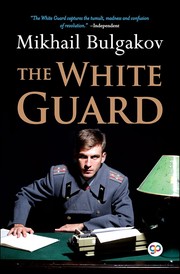 Mikhail Bulgakov · 1925The White GuardLvl 5Medium pace
 Mikhail Bulgakov · 1965Black SnowLvl 4Fast paced
 Mikhail Bulgakov · 1967The Master and MargaritaLvl 6Fast paced
 Nikolai Gogol · 1842Dead SoulsLvl 5Medium pace
 Vladimir Nabokov · 1955LolitaLvl 8Medium pace