
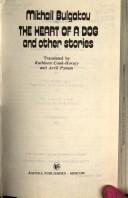
Heart of a Dog
Mikhail Bulgakov · 1891–1940 · Ukraine / Russia
Originally Sobachye Serdtse (Russian)
Why it matters
A professor transplants human glands into a stray dog and produces a perfect Soviet citizen: satire so lethal it stayed banned for sixty years. The sharpest short indictment of the New Man ever written.
At a glance
A short, brisk satire whose bite lies in political allusion rather than difficult prose.
Deep dive
A Moscow surgeon transplants human glands into a stray dog to prove a point about evolution, and gets, instead, a live demonstration of exactly what the Soviet 'New Man' looks like from the inside.
Written for readers who have finished the book. No plot recap, and nothing here is safe to read first.
Themes & symbolism
Professor Preobrazhensky's operation, grafting the pituitary gland and testes of a dead man onto the stray Sharik, is framed early as pure scientific ambition, rejuvenation research with no political angle at all, which is precisely why its result lands as such a sharp joke: the humanized dog doesn't turn into a better version of anyone, he turns into Sharikov, a foul-mouthed, thieving, self-righteous new citizen who inherits every one of his donor's worst habits and none of Preobrazhensky's own considerable refinement. Bulgakov's satire isn't aimed at the working class so much as at the fantasy that surgery, or ideology, can manufacture a 'New Soviet Man' by rearranging raw material without regard for what that material actually was.
Shvonder, the house committee chairman who takes Sharikov under his wing and coaches him in the language of proletarian entitlement, gives the satire its sharpest edge: Sharikov's crudeness becomes politically useful the moment someone teaches him to dress it up as class consciousness, and his sudden appointment purging Moscow's stray cats, a job that suits his literal dog nature perfectly, reads as Bulgakov's blackest joke about what kind of person a bureaucracy is actually equipped to reward. Preobrazhensky's growing horror at his own creation is horror at a system, not just an animal, that keeps mistaking crude appetite for revolutionary virtue.
Banned for Sixty Years for Being Too Accurate
Bulgakov wrote Heart of a Dog in 1925 and it was seized by the OGPU secret police from his apartment before he could publish it, along with his diaries; it circulated only in samizdat for decades and didn't appear legally in the Soviet Union until 1987, during glasnost. Bulgakov, a trained physician himself before he turned to writing, gave Preobrazhensky his own professional precision and his own class anxieties, and paid for the satire's clarity with years of being effectively unpublishable, surviving mainly on theater work and a personal, unlikely telephone call from Stalin that kept him from arrest without ever restoring his access to print. The word 'Sharikovism' entered Russian as shorthand for exactly the type Bulgakov diagnosed, an aggressively entitled mediocrity dressed in borrowed political virtue, a coinage that has long outlived the specific bureaucracy that produced it.
The last seal: what actually happens, and why it lands the way it does.
The ending, explained
Sharikov's behavior escalates past nuisance into real danger: he denounces Preobrazhensky to the authorities using the same bureaucratic language Shvonder taught him, and threatens the professor and his assistant Bormenthal with a revolver he's acquired through his pest-control job. Preobrazhensky and Bormenthal respond by doing to Sharikov exactly what was done to Sharik, operating again to reverse the transplant, and the novel's final pages show the professor's household back to normal, Sharik once more an ordinary, contented dog with only fragmentary, half-understood memories of having briefly been a man. Bulgakov ends on that restored calm rather than on punishment or reckoning, which is its own quiet verdict: the experiment can be undone in this one household, but the world that produced Shvonder and rewarded Sharikov is left completely untouched outside the professor's door.
Where to go next
 Mikhail Bulgakov · 1925The White GuardLvl 5Medium pace
 Mikhail Bulgakov · 1925The Fatal EggsLvl 3Fast paced
 Mikhail Bulgakov · 1965Black SnowLvl 4Fast paced
 Mikhail Bulgakov · 1967The Master and MargaritaLvl 6Fast paced
 Nikolai Gogol · 1842Dead SoulsLvl 5Medium pace
 Vladimir Nabokov · 1955LolitaLvl 8Medium pace