
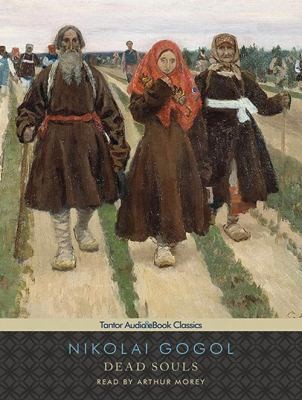
Dead Souls
Nikolai Gogol · 1809–1852 · Ukraine / Russia
Originally Myortvye Dushi (Russian)
Why it matters
A smooth operator tours the provinces buying deceased serfs still on the census: Russia's founding comic epic. Gogol's grotesque portraits and swerves into lyric grief invented the tradition's signature blend: laughter with an abyss under it.
At a glance
Digressive, ornate narration and abrupt lyrical asides slow an otherwise episodic plot.
Deep dive
The real, strange story behind the book's unfinished shape, and what Chichikov's ledger of dead men says about serfdom as bureaucratic fiction.
Written for readers who have finished the book. No plot recap, and nothing here is safe to read first.
Themes & symbolism
Chichikov is a new kind of Russian trickster: not a swindler of the old semi-feudal kind, loyal to land and to people, but a purely modern operator working the gap between the census, rare and expensive, and the fact of death, frequent and unrecorded until the next count — buying dead souls who are legally still alive on paper so he can mortgage them as collateral he'll never have to produce. Gogol's satire lands because the con isn't really Chichikov's; it's the system's, a serfdom so completely reduced to accounting that human beings and their absence are equally negotiable line items. Every landowner Chichikov visits is a different way of being dead already — Manilov's sugary vacancy, Korobochka's suspicious hoarding, Nozdryov's compulsive lying, Plyushkin's rot into a miser who can't remember what he's hoarding for — so that by the time Chichikov leaves each estate, the title is working two ways at once: the peasants on the ledger, and the landowners who sold them.
Gogol calls the book a poema, a poem, an odd claim for a comic prose satire, and he means it: the narrator keeps breaking from grotesque comedy into sudden lyric flight, most famously apostrophizing Russia itself as a speeding troika tearing forward while other nations stand back and make way. That whiplash between the grotesque and the sublime is Gogol's real invention, and the thing every Russian writer after him inherits — laughter that turns, without warning, over an abyss.
Why there's no ending
Gogol conceived Dead Souls as the first part of a three-volume structure modeled on Dante — this volume as Inferno, with two more meant to march Chichikov through a kind of purgatorial reform toward a Paradiso of virtuous, redeemed Russians. He spent years on Part Two, fell under the influence of a fanatical priest during a severe religious crisis, became convinced his own comic gift was sinful and the book itself a spiritual danger, and burned the nearly finished manuscript days before he died in 1852 — reportedly not the first draft of it he'd destroyed. Scattered fragments of an earlier draft survive and are sometimes printed as a Part Two, but they're incomplete, uneven, and were never meant to stand as his final word. What we have is Inferno without Purgatorio or Paradiso — a hell with no promised way out, which may be the most honest shape the book could have taken anyway.
Where to go next
 Nikolai Gogol · 1835Diary of a MadmanLvl 4Medium pace
 Nikolai Gogol · 1835Taras BulbaLvl 4Fast paced
 Nikolai Gogol · 1836The NoseLvl 3Fast paced
 Nikolai Gogol · 1836The Government InspectorLvl 3Fast paced
 Nikolai Gogol · 1842The OvercoatLvl 3Medium pace
 Fyodor Dostoevsky · 1866Crime and PunishmentLvl 6Fast paced