
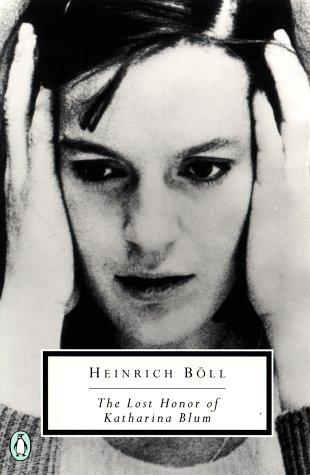
The Lost Honour of Katharina Blum
Heinrich Böll · 1917–1985 · Germany
Originally Die verlorene Ehre der Katharina Blum (German)
Why it matters
An ordinary woman's life is destroyed by a smearing tabloid after one night with the wrong man. Böll's lean, furious parable about the press, reputation, and the violence of headlines.
At a glance
A lean, fast, almost reportorial style deliberately mimics tabloid documentation.
Deep dive
What one tabloid reporter's version of a single night costs a woman who did nothing the law can actually charge her with, and what she finally does about it.
Written for readers who have finished the book. No plot recap, and nothing here is safe to read first.
Themes & symbolism
Böll subtitles the novel with a promise of documentary neutrality, how violence develops and where it can lead, and then builds the whole plot as evidence for that thesis: Katharina spends one night with a man the police suspect of robbery and possible terrorism, and the newspaper reporting on her afterward, led by the journalist Werner Tötges, doesn't need to prove anything against her, only imply enough to destroy a reputation she'd spent her adult life building through disciplined, private respectability.
The novel's lean, near-reportorial prose, clipped and documentary rather than emotionally editorializing, is itself the argument: Böll writes Katharina's destruction in exactly the flat, fact-forward register the tabloid claims for its own coverage, exposing by imitation how easily that register can be weaponized, how 'just reporting the facts' can constitute character assassination when the selection of facts is the actual crime. Even the novel's chapter headings and clinical asides, noting sources and dates with mock-official precision, borrow the same evidentiary posture Tötges's own paper claims, so that Böll's method and the tabloid's method end up sharing a surface neither one would want the other credited with.
A Novel Written From Böll's Own Police File
Böll wrote this after tabloids, chiefly the Bild newspaper, accused him of sympathizing with the Baader-Meinhof group and police searched his own home on the strength of that reporting; the novel is not an abstract parable about media ethics but a direct, furious transposition of his own experience onto an invented private citizen with far less power than a Nobel-adjacent public figure to fight back. That personal stake is what keeps the book's anger from curdling into a thesis statement: it reads like testimony as much as fiction.
Ludwig Götten as the Novel's Real Absence
The man Katharina spends one night with, wanted in connection with robbery and suspected terrorism, is kept almost entirely offstage, a rumor with a name rather than a fully rendered character, and Böll's refusal to let readers form their own independent judgment of him is deliberate. Whether Götten actually deserved the manhunt around him is beside the point the novel is making: Katharina's ruin never depended on his guilt or innocence in the first place, only on the tabloid's need for a story compelling enough to sell papers.
The last seal: what actually happens, and why it lands the way it does.
The ending, explained
Katharina, systematically stripped of her privacy, her friendships, and her professional standing by weeks of Tötges's coverage, arranges an interview with him under the pretense of finally telling her side, and shoots him dead once he's in her apartment, then turns herself in immediately. Böll refuses any courtroom vindication or catharsis: the novel simply stops with the killing and the surrender, an act of violence the whole book has spent its length explaining without asking the reader to forgive, since forgiveness was never really the target. The target was showing exactly how a headline manufactures the violence it later reports on with such shock.
Where to go next
 Heinrich Böll · 1955The Bread of Those Early YearsLvl 3Medium pace
 Heinrich Böll · 1959Billiards at Half-Past NineLvl 7Slow burn
 Heinrich Böll · 1963The ClownLvl 5Medium pace
 Heinrich Böll · 1971Group Portrait with LadyLvl 6Slow burn
 Günter Grass · 1959The Tin DrumLvl 8Medium pace
 Bernhard Schlink · 1995The ReaderLvl 3Medium pace