
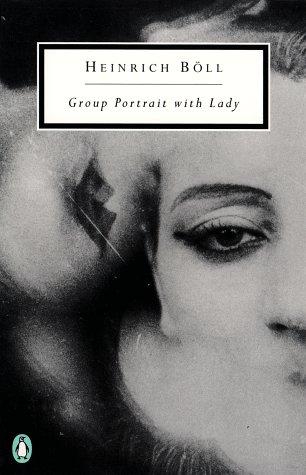
Group Portrait with Lady
Heinrich Böll · 1917–1985 · Germany
Originally Gruppenbild mit Dame (German)
Why it matters
An unnamed investigator assembles the life of Leni Pfeiffer from dozens of witness testimonies, a documentary mosaic of one unconventional woman's survival through Nazi Germany and its aftermath. The novel that anchored Böll's Nobel citation.
At a glance
A collage of interviews and documents narrated by an intrusive investigator-narrator requires patience with its mosaic form.
Deep dive
Why an anonymous investigator has to interview dozens of witnesses, a nun, a communist, a Soviet prisoner of war's son, to assemble one German woman's life, and what that method says about writing history after Nazism.
Written for readers who have finished the book. No plot recap, and nothing here is safe to read first.
Themes & symbolism
Böll refuses Leni Pfeiffer, née Gruyten, a conventional narrator. Instead an unnamed investigator, credited only as "Verf." for Verfasser, author, interviews dozens of witnesses, her old friend Lotte Hoyser, the nun Sister Rahel, the Soviet prisoner Bogakov, her tenants and neighbors, and assembles Leni's life the way a court or a journalist would, through testimony that contradicts, corroborates, and gossips rather than through omniscient narration. The method insists that a life lived through the Third Reich, its aftermath, and West Germany's amnesiac prosperity cannot be delivered whole by a single trustworthy voice; it can only be triangulated, and the gaps between witnesses are where the truth actually sits.
Leni's appetite, for bread, for coffee, for Schubert played on the organ, for sex without guilt, runs through the testimony as a stubborn refusal of both Nazi discipline and postwar bourgeois respectability. Böll treats her unideological hunger for pleasure as the closest thing to ethical clarity anyone in the book manages: while the Reich demands sacrifice and the new Federal Republic demands forgetting, Leni simply keeps wanting what she wants, in a body nobody else in the novel trusts as much as she does her own.
Rassenschande: An Affair the Reich Made a Capital Crime
Leni falls in love with Boris Lvovich Koltovsky, a Soviet prisoner of war forced to labor beside her at the Pelzer wreath-making firm, at a moment when relations between a German woman and an "Ostarbeiter" fell under Rassenschande, racial defilement, a charge the Reich punished with death. Their son Lev is born amid Cologne's ruins in the war's final days. Böll gives the affair no melodrama, only the plain fact that loving Boris was, under the regime governing every other choice in Leni's life, the single most dangerous and most human thing she ever did.
Hubert Gruyten's Fraud on the Reich
Leni's father, a building contractor, spends the war systematically defrauding the Nazi construction economy, padding requisitions and inventing projects with his wife's help, treating sabotage as ordinary commerce rather than heroic resistance. Böll uses Gruyten's scheme, eventually discovered, to puncture any tidy postwar story about German opposition to the regime: profiteering off a corrupt system, it turns out, required no ideology at all, just an eye for its weak points.
The last seal: what actually happens, and why it lands the way it does.
The ending, explained
Boris survives the war by forging papers that disguise him as a German rather than a Soviet prisoner, avoiding forced repatriation to Stalin's USSR, only to be arrested by French occupying forces and die of pneumonia and mistreatment in a French camp after the fighting has officially ended, the war's cruelty outlasting its own armistice for one man specifically. Leni, impoverished, rents rooms to immigrant workers, including the Turkish laborer Mehmet Sahin, who becomes her companion. Facing eviction, she is saved not by family, church, or state but by an improvised alliance of communists, nuns, criminals, and tenants who pool money to keep her housed. The "group portrait" the title promises delivers its real subject only here: solidarity assembled from society's discarded margins, doing what every official institution in Leni's life had already failed to do.
Where to go next
 Heinrich Böll · 1955The Bread of Those Early YearsLvl 3Medium pace
 Heinrich Böll · 1959Billiards at Half-Past NineLvl 7Slow burn
 Heinrich Böll · 1963The ClownLvl 5Medium pace
 Heinrich Böll · 1974The Lost Honour of Katharina BlumLvl 4Fast paced
 Günter Grass · 1959The Tin DrumLvl 8Medium pace
 Bernhard Schlink · 1995The ReaderLvl 3Medium pace