
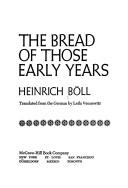
The Bread of Those Early Years
Heinrich Böll · 1917–1985 · Germany
Originally Das Brot der frühen Jahre (German)
Why it matters
A young repairman engaged to his boss's daughter is upended by the sudden return of a childhood friend from the hunger years, memory of postwar scarcity breaking his complacent present in two. A slim, early Böll parable of what prosperity makes people forget.
At a glance
A short, compressed novella with a simple, direct narrative line.
Deep dive
A young appliance repairman engaged to a life of postwar comfort finds one afternoon enough to undo every arrangement he's made for himself.
Written for readers who have finished the book. No plot recap, and nothing here is safe to read first.
Themes & symbolism
Walter Fendrich's childhood hunger during and just after the war, the scramble for bread specifically, the shame of begging or stealing it, the memory of adults hoarding loaves while children went without, sits under every comfortable detail of his present life as a successful young repairman in West Germany's booming postwar economy. Boll keeps returning to bread as the concrete, almost sacramental measure of what scarcity actually felt like, so that Fendrich's current ease, warm rooms, good clothes, a well-off fiancee, reads less like security earned than like distance carefully maintained from a hunger he still remembers in his body.
His engagement to Ulla Wickweber, daughter of the boss who's effectively adopted him into prosperity, represents exactly the bargain Boll's postwar fiction keeps interrogating, comfort purchased by not looking too hard at what got left behind or forgotten to get there, a settlement he has never once had to defend out loud because no one in his new circle asks. When Fendrich is asked to collect Hedwig, the daughter of an old family friend arriving to study in the city, from the train station, her plainness and the direct, unguarded way she carries her own more recent memories of hardship breaks through the amnesia his engagement to Ulla depends on, and he recognizes in a single afternoon that he's been mistaking calculation for feeling.
The Economic Miracle's Moral Debt
Boll wrote against the backdrop of West Germany's Wirtschaftswunder, the rapid economic recovery of the 1950s under Chancellor Adenauer that let a generation of Germans build new prosperity while largely declining to reckon publicly with the recent Nazi past. As a Catholic writer associated with Group 47, the postwar circle of German authors insisting on moral seriousness against exactly this kind of forgetting, Boll uses Fendrich's small personal crisis, a choice between a secure fiancee and an unglamorous woman who reminds him of what hunger actually felt like, as a compressed version of the country's larger choice between comfortable amnesia and honest reckoning.
Ulla Is Never Made the Villain
Boll resists the easy move of turning Ulla Wickweber into a caricature of shallow postwar wealth to justify Fendrich's decision to leave her: she is written as ordinary and largely blameless, a young woman who has simply never had to think about bread the way Fendrich secretly still does. That fairness is the harder, more honest version of the argument the novella is making, that Fendrich isn't choosing a better person over a worse one, he is choosing to stay loyal to a memory Ulla was never given any reason to share, which makes his decision a private reckoning rather than a public verdict on her.
The last seal: what actually happens, and why it lands the way it does.
The ending, explained
Within the span of a single day, Fendrich breaks his engagement to Ulla and commits himself instead to Hedwig, a decision Boll renders as impulsive but not shallow, a man choosing to stay connected to the hunger he remembers rather than continue building a life designed to insulate him from it. The novella offers no scene of confrontation with Ulla's wealthy family and no guarantee that Fendrich and Hedwig's future will be materially secure; what it offers instead is the smaller, harder claim that recognizing what you actually value, after years of drifting toward what's simply available, counts as its own kind of ending even without a settled outcome attached to it.
Where to go next
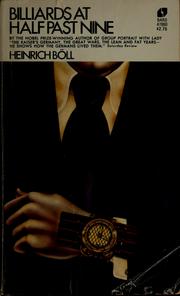 Heinrich Böll · 1959Billiards at Half-Past NineLvl 7Slow burn
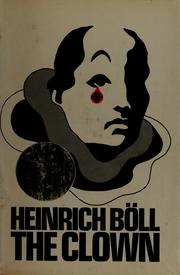 Heinrich Böll · 1963The ClownLvl 5Medium pace
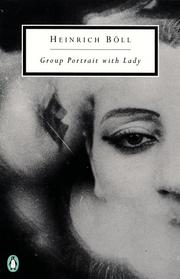 Heinrich Böll · 1971Group Portrait with LadyLvl 6Slow burn
 Heinrich Böll · 1974The Lost Honour of Katharina BlumLvl 4Fast paced
 Günter Grass · 1959The Tin DrumLvl 8Medium pace
 Bernhard Schlink · 1995The ReaderLvl 3Medium pace