
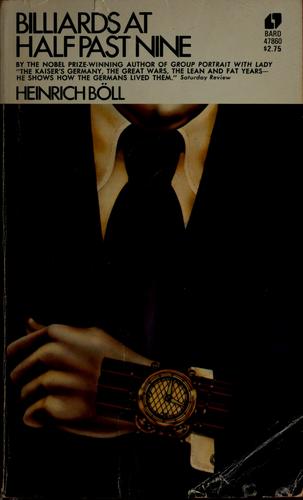
Billiards at Half-Past Nine
Heinrich Böll · 1917–1985 · Germany
Originally Billard um halbzehn (German)
Why it matters
Three generations of a Cologne family of architects converge on a single day in 1958, their private choices under Weimar, Nazism, and reconstruction refracted through a single billiards game. Böll's most structurally ambitious novel, guilt and complicity handed down like a trade.
At a glance
Shifting narrators and a single day's frame concealing decades of buried history demand careful piecing-together.
Deep dive
Why an architect's family keeps sorting itself, across three generations and one single day, into eaters of two different sacraments.
Written for readers who have finished the book. No plot recap, and nothing here is safe to read first.
Themes & symbolism
Böll compresses eighty years of German history into a single day, the eightieth birthday of the architect Heinrich Fähmel, and lets memory do the work a conventional flashback structure would spread across chapters: three generations of Fähmels narrate the same handful of events from inside their own heads while sitting in cafés, offices, and billiard rooms only streets apart. The novel's organizing image is Robert Fähmel's private taxonomy, learned as a schoolboy and never abandoned, that sorts everyone he meets into those who partake of the sacrament of the buffalo, meaning violence, conformity, and complicity, and those who partake of the sacrament of the lamb, meaning its victims and its refusers. It's a crude binary and Böll knows it, but he uses its crudeness deliberately: after the Third Reich, Robert argues, refusing to sort people at all is its own kind of cowardice.
Heinrich built the Abbey of St. Anthony as a young architect at the height of his optimism; Robert, working as a demolitions expert near the war's end, blows it up himself, not for any tactical necessity but as a private, near-suicidal act of protest against a war he can no longer bear to be an instrument of. That the son destroys exactly what the father spent his career creating is Böll's clearest image of what Nazism actually cost Germany: not only the dead, but a continuity between generations that the war itself severed, leaving a family able to sit at the same table and mean entirely different things by the same words.
Nettlinger's Untroubled Return
Nettlinger, who terrorized Robert's schoolboy circle under the Nazis and had Robert's friend Schrella hunted for arrest, reappears at the novel's present moment as a respected, well-fed municipal official, greeting Robert with the easy warmth of an old classmate rather than a man who once held real power over his life. Böll refuses to give Nettlinger a comeuppance; his prosperity is the point, a portrait of exactly how thoroughly West Germany's postwar recovery let its most active collaborators back into ordinary civic life, while Schrella, who fled the country to survive, returns after decades to find himself still effectively a stranger in it.
A Novel Built From One September Day
Böll sets the entire novel within roughly nine hours on September 6, 1958, and never leaves that window even as the interior monologues range back across fifty years of German history, a structural choice that makes the day itself feel like a courtroom the past keeps getting summoned into. Writing as part of the Gruppe 47 generation of postwar West German writers committed to confronting rather than burying the recent past, Böll builds the novel's fragmentary, multiple-narrator form directly out of that project: history here isn't told in sequence because no single member of the family experienced it in sequence, and the day's ordinary errands, billiards, a birthday cake, a visit to a café, keep interrupting and being interrupted by war memories that never stopped being current.
The last seal: what actually happens, and why it lands the way it does.
The ending, explained
The birthday party assembles all three generations under one roof for the first time in the novel, and it's Johanna, Heinrich's wife, released for the day from the sanatorium where the family has kept her since a wartime breakdown, who provides the last violent act: she produces an old pistol and fires at a former Nazi official attending as a guest, a man whose politics never cost him anything after 1945. No one stops her and the shot barely disrupts the party, Böll's flattest, angriest joke about how little postwar Germany was actually prepared to punish. The cake, baked in the shape of the abbey Heinrich built and Robert destroyed, is cut and handed around to the whole family in the final pages, an act of communion that doesn't resolve the buffalo and the lamb into one thing so much as insist the family eat their own history together rather than keep sorting each other by it.
Where to go next
 Heinrich Böll · 1955The Bread of Those Early YearsLvl 3Medium pace
 Heinrich Böll · 1963The ClownLvl 5Medium pace
 Heinrich Böll · 1971Group Portrait with LadyLvl 6Slow burn
 Heinrich Böll · 1974The Lost Honour of Katharina BlumLvl 4Fast paced
 Günter Grass · 1959The Tin DrumLvl 8Medium pace
 Bernhard Schlink · 1995The ReaderLvl 3Medium pace