
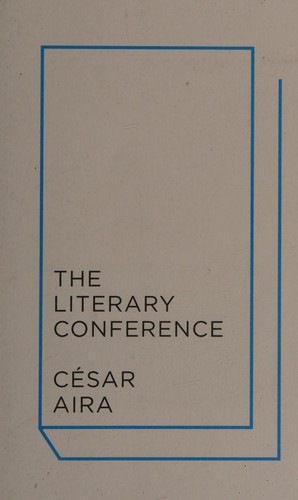
The Literary Conference
César Aira · b. 1949 · Argentina
Originally El congreso de literatura (Spanish) · translated by Katherine Silver
Why it matters
A mad scientist-translator attempts to clone Carlos Fuentes in order to build an army and take over the world, with predictably chaotic results. Aira's wildest genre mashup, pure improvisation pushed to gleeful extremes.
At a glance
Freewheeling, digressive improvisation resists any conventional plot logic.
Deep dive
A treasure hunter turned mad scientist sets out to clone the world's greatest living novelist for an army of world-conquering geniuses, and gets something considerably stranger instead.
Written for readers who have finished the book. No plot recap, and nothing here is safe to read first.
Themes & symbolism
César, Aira's transparent authorial stand-in, opens the book already a mad scientist with a secret plan for world domination, and the novel spends its first pages solving his money problem almost contemptuously: a walk on a beach lets him intuitively crack the centuries-old Macuto Line pirate cipher, and he's instantly, effortlessly rich. He goes to the literary conference in Mérida anyway, ostensibly because a theater company is staging his own Adam-and-Eve-as-serial-killer play, but really because Carlos Fuentes will be there, and César has trained a cloning wasp to extract a cell from him. The target isn't personal admiration. César wants an army of Fuentes clones obedient enough to help him rule the world, on the theory that the world's most celebrated living novelist must also be its most efficient possible henchman.
The wasp, sent to collect Fuentes's genetic material, instead comes back with a fiber from his silk necktie, and César, rather than abandon the experiment, feeds the sample into his cloning machine and turns the dial to its most extreme setting anyway. What emerges isn't a Fuentes at all: colossal blue silkworms, each reportedly some thousand feet long, descend from the mountains above Mérida and start burying the city in landslides. Aira narrates the catastrophe in exactly the same unhurried, matter-of-fact prose he's used for the treasure hunt and the conference gossip, refusing to shift into disaster-movie urgency even as the scale of the threat becomes genuinely apocalyptic, which is the novel's real joke: literary ambition and giant mutant silkworms turn out to deserve the identical narrative register.
A Treasure Plot Solved So It Can't Matter
Most adventure novels would spend their whole length on a hunt like the Macuto Line puzzle. Aira disposes of it in a handful of pages specifically so it can't generate any of the suspense a conventional plot would extract from it, leaving César rich before the story has properly started and free to spend the rest of the book on an ambition money was never going to satisfy anyway. The gesture is characteristic: Aira keeps demonstrating that the machinery of a normal well-made plot bores him, and would rather burn through an entire novel's worth of premise in a single opening digression than let it structure anything.
Cloning Genius Instead of Earning It
Fuentes stands in for the whole cult of literary greatness that surrounds a conference like this one, and César's plan, to extract and mass-produce that greatness rather than simply admire it from the audience, satirizes the fantasy that genius is a substance you could isolate in a lab rather than a lifetime's accumulated labor. It's a needling joke aimed partly at Aira's own famous contemporaries from the Boom generation, and partly at himself: a writer who has built an entire career out of refusing revision and courting productive accident is the last person who should believe genius can be synthesized on command, which is exactly why his stand-in's experiment goes so spectacularly, gorgeously wrong.
Where to go next
 César Aira · 1990GhostsLvl 5Slow burn
 Jorge Luis Borges · 1944FiccionesLvl 7Slow burn
 Adolfo Bioy Casares · 1940The Invention of MorelLvl 5Fast paced
 Ricardo Piglia · 1980Artificial RespirationLvl 8Slow burn
 Silvina Ocampo · 1959Thus Were Their FacesLvl 5Fast paced
 Julio Cortázar · 1959Blow-Up and Other StoriesLvl 6Medium pace