
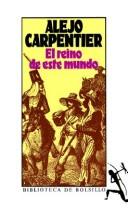
The Kingdom of This World
Alejo Carpentier · 1904–1980 · Cuba
Originally El reino de este mundo (Spanish) · translated by Harriet de Onís
Why it matters
The Haitian Revolution told through voodoo, metamorphosis, and the belief of the enslaved. Carpentier's short novel and its famous prologue founded 'the marvelous real,' the seed of magical realism.
At a glance
Short but densely allusive mythic prose compresses decades of revolution into few pages.
Deep dive
Why a novel about the Haitian Revolution keeps circling back to metamorphosis, and what it means that the book's most famous idea appears not in the story but in its prologue.
Written for readers who have finished the book. No plot recap, and nothing here is safe to read first.
Themes & symbolism
Metamorphosis is Carpentier's answer to a historical problem: how do you narrate an uprising from inside a belief system — Voodoo cosmology — that the colonizer's own language has no honest words for? Mackandal's shapeshifting is never adjudicated by the novel as true or false; Carpentier simply narrates it from within the enslaved community's conviction, so that the mongoose, the iguana, the wasp he supposedly becomes are as real as the plantation ledgers. That refusal to rationalize is the book's method and its politics at once: French colonial reason gets no narrative authority over African belief, they simply coexist as rival realities.
The deeper structure is cyclical rather than progressive. Ti Noël lives through three regimes that each promise the end of bondage and each reinstate it in a new uniform: French slavery, Henri Christophe's Black monarchy (which conscripts the same bodies to build the Citadelle that Christophe will later use to imprison his own subjects), and finally a Mulatto republic that puts the old plantations back to profitable use under new management. Power in this novel doesn't fall, it changes clothes — which is what makes Ti Noël's late-life transformations into animals a form of protest rather than escapism: when every human hierarchy just recycles the last one's cruelty, ceasing to be human, even briefly, is the only exit anyone's found.
Lo Real Maravilloso
The novel's prologue is arguably more consequential than the story that follows it: Carpentier, writing after a research trip to Haiti in 1943, coined lo real maravilloso americano — the marvelous real — to distinguish what he'd witnessed there from European Surrealism, which he dismissed as a manufactured, parlor-trick wonder assembled by writers straining for effect. Haiti, he argued, didn't need manufactured marvels; its actual history — a slave rebellion led by men who believed in shapeshifting, a Black king who built a fortress in the clouds — already exceeded anything Breton could invent, because it was simply true and simply lived. That distinction, between wonder imposed on reality and wonder found already embedded in it, is the founding document of magical realism two decades before the term existed, and García Márquez, among many others, wrote in its wake.
The last seal: what actually happens, and why it lands the way it does.
The ending, explained
In old age, Ti Noël — his revolutionary hopes exhausted, his body worn out, watching a new Mulatto elite work the same land with the same whips under a different flag — draws on the Voodoo knowledge Mackandal once embodied and wills himself into a series of animal forms: a bird, a stallion, a wasp, a colony of ants, trying out each body as a possible permanent escape from a human world that keeps reinventing its own oppression. Each form eventually fails him or bores him or simply isn't sustainable, and he returns, at the end, to his own aged human body, where he dies. Carpentier closes with a much-quoted meditation, delivered as authorial reflection rather than character's thought: that mankind's greatness lies not in any triumph over its condition but in the perpetual, undefeated obligation to keep striving within it — 'in the Kingdom of Heaven there is no grandeur to be won, inasmuch as all is established hierarchy... whereas in the Kingdom of this World' greatness consists of demanding one's due within a world of enduring sorrow. It's a hard-won, qualified affirmation, not a happy ending: the novel has just shown three consecutive regimes fail Ti Noël, and the closing line asks the reader to keep faith anyway, precisely because the alternative is surrender.
Where to go next
 Alejo Carpentier · 1953The Lost StepsLvl 6Slow burn
 Elena Garro · 1963Recollections of Things to ComeLvl 7Slow burn
 Gabriel García Márquez · 1967One Hundred Years of SolitudeLvl 6Medium pace
 Miguel Ángel Asturias · 1946El Señor PresidenteLvl 8Slow burn
 Juan Rulfo · 1955Pedro PáramoLvl 7Slow burn
 Mariano Azuela · 1915The UnderdogsLvl 4Fast paced