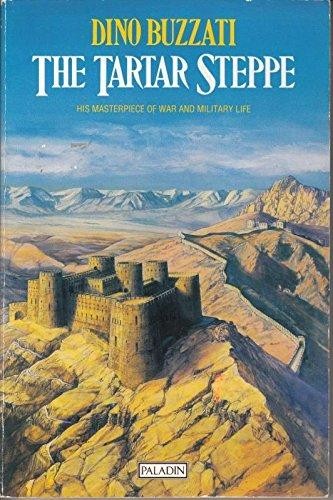
The Tartar Steppe
Dino Buzzati · 1906–1972 · Italy
Originally Il deserto dei Tartari (Italian)
Why it matters
A young officer arrives at a remote frontier fortress expecting brief duty and stays a lifetime, watching for an invasion that never comes. A parable of wasted waiting and the life quietly spent while awaiting meaning elsewhere.
At a glance
Plain prose, but its glacial pacing is itself the difficulty.
Deep dive
A young officer is posted to a remote frontier fortress to wait for an invasion that may never come, and Buzzati spends decades of his life, and the reader's patience, finding out what waiting does to a man who was promised glory.
Written for readers who have finished the book. No plot recap, and nothing here is safe to read first.
Themes & symbolism
Giovanni Drogo arrives at Fort Bastiani meaning to request a transfer within months, finding the isolated post and its obsessive watch over the empty Tartar steppe absurd, and Buzzati's quiet trick is to have him stay anyway, for one more season, then one more, each delay justified by the same logic: leaving now would mean admitting that everything already spent waiting was wasted. The steppe itself, flat, empty, and visible from the fort's ramparts for the entire novel, carries almost no physical description because its real content is time, the enemy that never quite arrives standing in for every deferred ambition a life gets spent anticipating instead of living.
The fort's elaborate rituals, sentry rotations, password exchanges, ceremonial inspections, exist to dignify a purpose that may not exist at all, and Buzzati lets his officers invest those rituals with real meaning precisely because the alternative, admitting the watch is pointless, is unbearable. The novel's affinity with Kafka is real but its target is different: where Kafka's bureaucracies frustrate a desire to reach something, Bastiani's frustrates nothing so much as time itself, turning military readiness into a slow-motion allegory for anyone who has organized a life around a decisive moment that keeps not coming.
Drogo's few returns to the city and to a woman he might have married only sharpen the trap: civilian life, glimpsed briefly between postings, no longer fits him, and each visit sends him back to Bastiani faster than duty alone would explain, since the fort has become the only place his wasted years still make a kind of sense. Buzzati gives that pull no villain to blame, only the ordinary machinery of habit and sunk cost, which is what makes the novel's portrait of self-deception land as diagnosis rather than melodrama.
A War Novel With No War In It
Buzzati wrote the novel while working as a crime reporter in Milan, in a newsroom whose routines he found similarly circular, and the fort's endless watch reads as much as an allegory of any institutional career, journalism, the military, the civil service, as it does a specifically wartime story; the book was published in 1940 with fascist Italy already mobilizing, which gave contemporary readers an uncomfortably direct frame for a story ostensibly set nowhere in particular. Its power outlasted that context because the real subject was never the coming war but the shape a wasted life takes when it is wasted one reasonable postponement at a time.
The last seal: what actually happens, and why it lands the way it does.
The ending, explained
After more than thirty years at Bastiani, Drogo finally sees what the fort has waited for, an army genuinely massing on the steppe, at the exact moment illness has left him too weak to serve; his superiors, needing able bodies for the coming battle, dismiss him and send him away from the fort in a carriage before the fighting even starts. Buzzati denies Drogo the confrontation the entire novel has been organized around, replacing it with a smaller, harder one: dying alone at a roadside inn, Drogo composes himself deliberately, refusing to let his final hours be as passive as the decades that preceded them, and meets death with a private, unwitnessed dignity that the glorious battle he'll never see was never actually going to supply.