
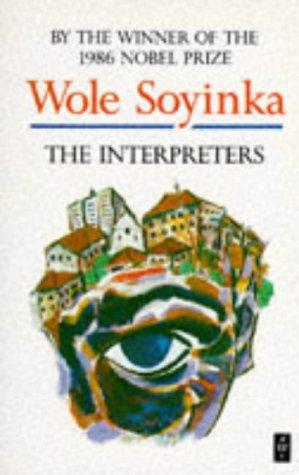
The Interpreters
Wole Soyinka · b. 1934 · Nigeria
Why it matters
Young Nigerian intellectuals drift through Lagos after independence, their idealism curdling into disillusionment. Soyinka's only novel, dense and satirical, from Africa's first Nobel laureate in literature.
At a glance
Nonlinear structure, dense allusion, and an ensemble cast make this notoriously demanding.
Deep dive
Five recently returned Nigerian intellectuals try to interpret an independence that has little use for their interpretations, and the group's own artist ends up painting them as a pantheon before anyone agrees on what they actually stand for.
Written for readers who have finished the book. No plot recap, and nothing here is safe to read first.
Themes & symbolism
Soyinka's title names its subject directly: Egbo, Sagoe, Kola, Bandele, and the engineer Sekoni have all returned from study abroad to newly independent Nigeria expecting to function as interpreters, translating a colonial education into something useful for the country that sent them away and is now supposed to receive them back transformed. What the novel actually shows is a group whose fluency in two worlds, Yoruba cosmology and Oxford seminar rooms, western technical training and indigenous ritual, leaves them oddly unable to act in either. Interpretation, Soyinka suggests, is not the same skill as intervention, and the gap between the two is where most of these men spend the entire novel stranded.
Sekoni is the group's clearest casualty of that gap: an engineer who returns from England eager to build, his dam project is stalled and effectively stolen through bureaucratic corruption before it produces a single watt, and the breakdown that follows pushes him toward sculpture instead, welding scrap metal into a piece he calls The Wrestler. It is the novel's most sincere object, art produced not as vocation but as the only channel left open once every institutional path to real work has been deliberately closed to him by men with less talent and more access.
Kola's Pantheon
Kola, the group's painter, spends much of the novel working on a mural that recasts his own friends as Yoruba orisha: Sekoni becomes Sango, the volatile god of thunder and technology; Sagoe becomes Esu, trickster and disruptor; Egbo becomes Ogun, god of iron, war, and creation, patron of exactly the kind of restless, unresolved energy Egbo carries around Lagos without ever discharging it productively. The mural doesn't decorate the novel's themes so much as state them outright, mapping mythic permanence onto men who are, in every other scene, defined by drift and indecision, and daring the reader to notice how much better the old gods explain these men than any modern vocabulary does.
The last seal: what actually happens, and why it lands the way it does.
The ending, explained
Sekoni's arc ends on a highway rather than in any of the corridors of power that broke his engineering career: driving in the rain, he collides with a lorry and is killed instantly, a death Soyinka stages with almost no ceremony, machinery destroying a man the way bureaucracy had already destroyed his work. The other four absorb the loss without it reorganizing their lives into anything more decisive; Egbo continues circling, unresolved, the question of whether to claim the traditional chieftaincy his drowned parents left him or stay in Lagos as a minor foreign-service clerk, and Sagoe returns to a publishing world too cynical to be shocked by anything he writes. Soyinka closes without granting the survivors a reckoning, which is the novel's real verdict on their generation: interpreters who never quite convert insight into action, even when one of their own has just been destroyed.
Where to go next
 Wole Soyinka · 1960A Dance of the ForestsLvl 8Slow burn
 Wole Soyinka · 1963The Lion and the JewelLvl 3Fast paced
 Wole Soyinka · 1973Season of AnomyLvl 8Slow burn
 Wole Soyinka · 1975Death and the King's HorsemanLvl 6Medium pace
 Ayi Kwei Armah · 1968The Beautyful Ones Are Not Yet BornLvl 6Slow burn
 Chinua Achebe · 1958Things Fall ApartLvl 4Medium pace