
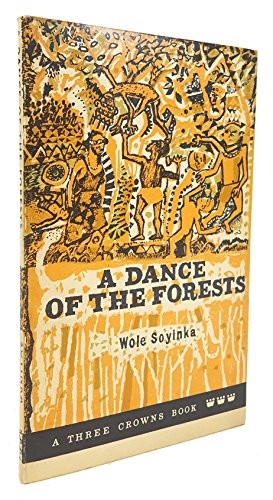
A Dance of the Forests
Wole Soyinka · b. 1934 · Nigeria
Why it matters
Commissioned for Nigeria's independence celebrations, then refused to deliver the rosy pageantry expected of it, summoning ancestral spirits who prove no more admirable than the living. Soyinka's first major play, dismantling nationalist nostalgia before it could even set in.
At a glance
Dense Yoruba cosmology, masquerade, and a nonlinear ritual structure make this Soyinka's most demanding play.
Deep dive
Nigeria's independence celebrations commissioned Soyinka to write a play honoring the nation's ancestors, and he sent back a ceremony that summons the dead and finds them exactly as flawed as the living.
Written for readers who have finished the book. No plot recap, and nothing here is safe to read first.
Themes & symbolism
Commissioned to mark Nigeria's independence in October 1960, Soyinka delivered a play built specifically to frustrate the celebration it was hired to provide: a community holding a 'gathering of the tribes' summons ancestral spirits expecting glorious, dignifying heroes, and receives instead the Dead Man and the Dead Woman, figures whose grievances turn out to implicate the living celebrants directly rather than flatter them. Soyinka's refusal of an easy nationalist pageant, delivered at the exact moment the new nation most wanted one, announced from the outset that his skepticism about postcolonial optimism would not soften for the occasion.
A play-within-the-play set in the historical court of the tyrant Mata Kharibu reveals that the Dead Man and Dead Woman, along with several of the living characters in altered form, already lived through one cycle of betrayal and cruelty centuries earlier, exposed as an enslaved soldier executed for refusing to fight an unjust war and the wife destroyed alongside him. Soyinka uses the doubled cast to argue that Nigeria's living generation is not a clean break from a corrupt precolonial or colonial past but a direct continuation of the same human failures, reincarnated rather than reformed, undermining any comforting story about a nation simply waiting, until independence, to become its best self.
Forest Head, a god-figure who moves through the play disguised as the ordinary man Obaneji, orchestrates the whole confrontation as a kind of forced reckoning, less interested in punishing the community than in making it actually look at what it has assembled to celebrate. The Half-Child, born onstage to the Dead Woman and immediately fought over by opposing spiritual forces representing the nation's future, gives the play its clearest image of what is actually at stake: an unfinished, contested future that the gathered community's self-congratulation is doing nothing to protect.
An Independence Play With No Independence Speech
Where the official 1960 celebrations Soyinka's play was written for ran on speeches about promise and progress, A Dance of the Forests offers no equivalent set piece, no character delivers anything resembling patriotic uplift, and the play's masque of dancers and spirits ends in confusion and unresolved threat rather than resolution. Soyinka's evasion of the genre his commission implicitly demanded is itself the play's argument, that a nation's actual reckoning with its own history cannot be scheduled to coincide with a ceremony designed to avoid one.
Casting the Living as Their Own Ancestors
Several actors play both a present-day character and that character's counterpart in the Mata Kharibu flashback, a doubling that forces the same body on stage to carry both the accusation and the accused across centuries. The device denies the audience the comfort of treating cruelty as something the past did to the present; Soyinka makes clear the present is still doing it, simply with the flashback's costumes removed.
Where to go next
 Wole Soyinka · 1963The Lion and the JewelLvl 3Fast paced
 Wole Soyinka · 1965The InterpretersLvl 8Slow burn
 Wole Soyinka · 1973Season of AnomyLvl 8Slow burn
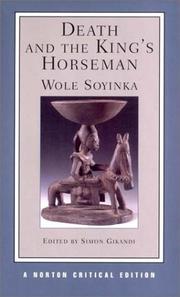 Wole Soyinka · 1975Death and the King's HorsemanLvl 6Medium pace
 Ayi Kwei Armah · 1968The Beautyful Ones Are Not Yet BornLvl 6Slow burn
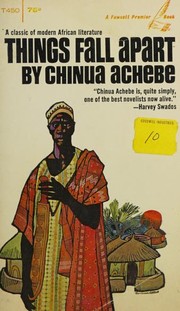 Chinua Achebe · 1958Things Fall ApartLvl 4Medium pace