
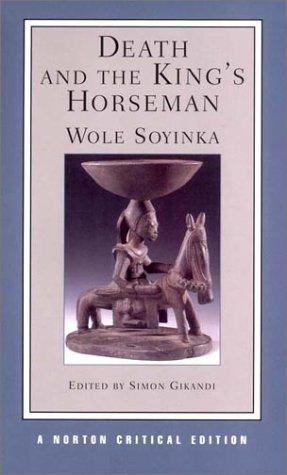
Death and the King's Horseman
Wole Soyinka · b. 1934 · Nigeria
Why it matters
A colonial official's interference derails the ritual suicide meant to accompany a dead Yoruba king into the afterlife, with catastrophic consequences for both cultures. Soyinka's most performed and studied play, built from a real 1946 incident.
At a glance
Dense Yoruba ritual language and cosmology require unpacking alongside the colonial plot.
Deep dive
Soyinka's own preface insists this isn't a play about culture clashing with tradition, and the real drama is what happens to a man's will in the hour he is finally asked to prove it.
Written for readers who have finished the book. No plot recap, and nothing here is safe to read first.
Themes & symbolism
Elesin Oba is not a passive tragic victim marked for death, he is the King's Horseman by hereditary office, and the play opens with him already relishing the honor: when a king dies, his horseman is expected to follow within a month so the king does not travel to the ancestors unaccompanied, and Elesin spends his opening scenes performing joy rather than dread, buying cloth, praising his own appetite for life, savoring the market women's attention. That eagerness is not incidental color. Soyinka is establishing a will at full strength before he tests what happens when the moment arrives to spend it, because the tragedy the play is building toward is a failure of that will, not an external obstacle to it.
Soyinka's own preface warns explicitly against reading the play as a clash between colonial and Yoruba values, calling the District Officer's intervention 'a catalytic incident merely' rather than the play's true subject, which he names as metaphysical: what happens to the fabric connecting the living, the dead, and the unborn when a man who exists to complete a specific transition instead hesitates at its threshold. Pilkings' obliviousness, his casual appropriation of an egungun ancestral costume for a colonial fancy-dress ball, his genuine belief he is rescuing Elesin from barbarism, is played for real damage, but Soyinka builds the design so that the arrest only interrupts a will that has already, in some private way, begun to waver.
Not a Clash of Cultures
Take Soyinka at his word and the play's center of gravity shifts entirely: the question stops being whether British colonial law had any right to stop an African ritual, and becomes whether Elesin, given every chance to act before Pilkings ever appears, would have completed his death on his own terms. His last-night marriage to a girl already promised to another man reads differently under this framing too, less like a man savoring final pleasures than like a man testing, one indulgence at a time, how much of the world he can still hold onto before he is required to let it go.
The last seal: what actually happens, and why it lands the way it does.
The ending, explained
Word reaches the prison that Olunde, Elesin's eldest son, has returned from medical school in England specifically because he assumed his father would already be dead by the time his ship docked; he has come home to bury him, not to save him. Confronted with his father still alive and in custody, and with the Praise-Singer's open contempt for a man who let himself be stopped, Olunde is the one who completes the world's business that night, restoring, through his own death, the transition his father could not finish. When Elesin finally understands what his son has done in his place, the shame is total: he strangles himself with the chain still binding him to his cell, and the district officer's wife and the market woman Iyaloja are left facing each other over two bodies instead of the single, honorable one the ritual had asked for.
Where to go next
 Wole Soyinka · 1960A Dance of the ForestsLvl 8Slow burn
 Wole Soyinka · 1963The Lion and the JewelLvl 3Fast paced
 Wole Soyinka · 1965The InterpretersLvl 8Slow burn
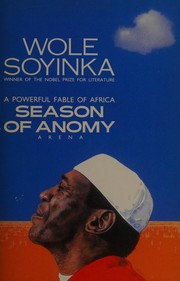 Wole Soyinka · 1973Season of AnomyLvl 8Slow burn
 Ayi Kwei Armah · 1968The Beautyful Ones Are Not Yet BornLvl 6Slow burn
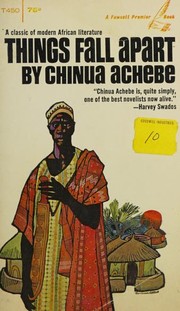 Chinua Achebe · 1958Things Fall ApartLvl 4Medium pace