
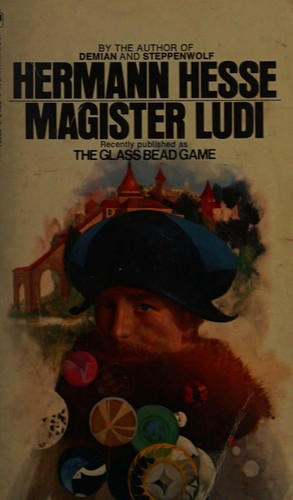
The Glass Bead Game
Hermann Hesse · 1877–1962 · Germany / Switzerland
Originally Das Glasperlenspiel (German)
Why it matters
In a future scholarly order devoted to a game that synthesizes all art and science, Magister Ludi Joseph Knecht slowly comes to doubt the cloistered life he has mastered. Hesse's final and most ambitious novel, the summa behind his Nobel Prize.
At a glance
A long, deliberately paced utopian frame novel dense with invented history and ideas.
Deep dive
A utopia of pure intellect produces its most gifted servant, who spends the whole novel discovering exactly what such a paradise leaves out.
Written for readers who have finished the book. No plot recap, and nothing here is safe to read first.
Themes & symbolism
Castalia, the elite intellectual province where Josef Knecht rises to become Magister Ludi — Master of the eponymous Game, an elaborate synthesis of mathematics, music, and every other discipline into pure symbolic form — is built as Hesse's most fully realized utopia and simultaneously his most pointed critique of one: a community that has achieved near-total detachment from politics, economics, and ordinary human need, sustaining a civilization of extraordinary intellectual refinement that produces nothing, reproduces nothing, and stands increasingly exposed as a beautiful, sterile withdrawal from the world that funds it.
Knecht's friendship with Plinio Designori, a gifted Castalian-trained outsider who chooses to leave the order and live in the fractious, compromised secular world, functions across the novel as the argument Knecht can't stop having with himself: Plinio's worldly life, with its politics, marriage, and struggle, is never romanticized as simply better, but it keeps demonstrating to Knecht that Castalia's purity has been purchased by systematically excluding exactly the kind of lived, consequential experience that gives meaning its weight in the first place.
Hesse frames the entire novel as a biography compiled by an admiring future Castalian historian, complete with an invented scholarly apparatus and Knecht's own poems and 'three lives' (imagined incarnations Knecht writes as a student exercise) appended at the end — a structural mirroring in which the fictional biographer's own limited, institutional perspective on Knecht's life becomes part of the novel's argument about how any single frame, including Castalia's, can only ever partially capture a life lived in genuine tension between contemplation and action.
Hesse's Late, Difficult Masterwork
Written across the 1930s and early 1940s and published in Switzerland in 1943, while Hesse's books were banned in Nazi Germany, The Glass Bead Game was explicitly conceived as a rebuke to the anti-intellectualism and barbarism Hesse saw overtaking Europe — Castalia's devotion to disinterested truth and beauty is a pointed inversion of a continent burning itself down around it. The novel's density, its invented terminology, and its refusal of conventional plot momentum make it Hesse's most demanding book by far, but it was cited specifically in his 1946 Nobel Prize in Literature as the capstone of a body of work devoted to exactly this tension between the contemplative and the active life.
The last seal: what actually happens, and why it lands the way it does.
The ending, explained
Having risen to the Game's highest office, Knecht comes to believe Castalia's isolation has become a moral failure rather than an achievement, and in a decision the elders regard as scandalous, resigns his Mastership to become private tutor to Plinio's son Tito, choosing engagement with a single pupil over governing the whole intellectual order. Almost immediately, eager to earn the skeptical, athletic Tito's respect, the aging, out-of-condition Knecht accepts a challenge to swim a cold mountain lake at dawn and drowns within minutes, his body simply unequal to the physical world he's just chosen to rejoin. Hesse gives no grand final statement — the death is abrupt, reported through Tito's shocked point of view rather than Knecht's own — and that abruptness is the point: after a whole novel inside Castalia's elaborate mastery of symbolic form, Knecht's actual death is undignified and instant, proof the world outside the Game plays by harder rules than the ones he'd spent his life perfecting.
Where to go next
 Hermann Hesse · 1919DemianLvl 5Slow burn
 Hermann Hesse · 1922SiddharthaLvl 3Medium pace
 Hermann Hesse · 1927SteppenwolfLvl 6Medium pace
 Hermann Hesse · 1930Narcissus and GoldmundLvl 4Slow burn
 Thomas Mann · 1912Death in VeniceLvl 6Slow burn
 Johann Wolfgang von Goethe · 1774The Sorrows of Young WertherLvl 3Medium pace