
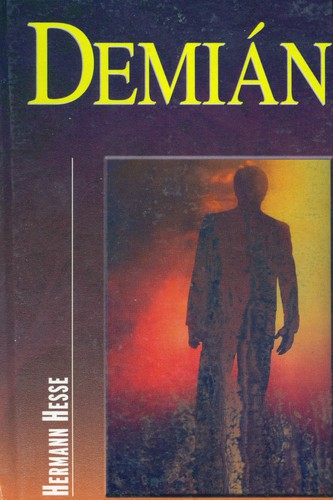
Demian
Hermann Hesse · 1877–1962 · Germany / Switzerland
Originally Demian (German)
Why it matters
Emil Sinclair is pulled out of childhood safety by the enigmatic Max Demian and into a lonely search for his own daimon. Hesse published it pseudonymously at forty-two, passing it off as a young man's debut; it became the shell-shocked postwar generation's bible.
At a glance
Dense Jungian symbolism and inward, essayistic passages slow a short bildungsroman.
Deep dive
Why the mysterious classmate who reads Cain's story backward turns out, by the novel's last page, to be less a separate person than a name for something Sinclair had in him all along.
Written for readers who have finished the book. No plot recap, and nothing here is safe to read first.
Themes & symbolism
Max Demian's first real lesson to the young Emil Sinclair is a deliberate inversion of Sunday-school certainty: he reads the story of Cain and Abel against the grain, suggesting the mark of Cain was not a curse at all but a sign of strength that frightened, ordinary people needed to reinterpret as evil in order to feel safe around him. Hesse uses that single reinterpretation to set the whole novel's method, every fixed moral category Sinclair has inherited from his sheltered, light-filled bourgeois household gets tested against a dark world of appetite and instinct he has been taught to fear rather than integrate.
Abraxas, the god Sinclair eventually learns of from the freethinking organist Pistorius, a deity who is neither purely divine nor purely demonic but both at once, gives that inversion its full theological shape: the famous image of the bird breaking out of its egg to fly toward Abraxas is not a call to abandon morality but to stop pretending a self can be built out of only its acceptable half. Sinclair's entire adolescence becomes the process of admitting that the appetite, violence, and sexuality he has been taught to wall off are as much his own as the qualities his mother approves of.
Demian and Sinclair, One Face
Hesse threads the possibility that Demian, and his enigmatic mother Frau Eva, whom Sinclair comes to love with an intensity closer to worship than romance, are less independent characters than externalized pieces of Sinclair's own psyche, a suggestion the novel never resolves outright but keeps reinforcing, culminating in a late scene where Sinclair, gazing into a mirror, sees Demian's face looking back rather than his own. Published pseudonymously under the name Emil Sinclair when Hesse was already forty-two, the book let a middle-aged, established writer pass off a young man's supposed debut as genuinely new, and an entire postwar generation, reading it as the discovery of an unknown peer rather than a master's late work, adopted its argument for self-realization as something closer to scripture.
The last seal: what actually happens, and why it lands the way it does.
The ending, explained
Sinclair and Demian are reunited by the outbreak of the First World War, both wounded on the same battlefield and laid in adjoining beds in a makeshift field hospital, and Demian, before losing consciousness, tells Sinclair that he will always be able to find him again simply by listening closely inside himself, since what Sinclair has been calling their friendship was always, at bottom, a conversation with a part of his own mind he needed a separate face to have it with. When Sinclair wakes, Demian is gone, and the final image, bandaged, alone, discovering that the kiss Demian left him with feels indistinguishable from a message arising from his own depths, closes the novel on individuation completed rather than friendship interrupted: the guide was never fully external to begin with.
Where to go next
 Hermann Hesse · 1922SiddharthaLvl 3Medium pace
 Hermann Hesse · 1927SteppenwolfLvl 6Medium pace
 Hermann Hesse · 1930Narcissus and GoldmundLvl 4Slow burn
 Hermann Hesse · 1943The Glass Bead GameLvl 7Slow burn
 Thomas Mann · 1912Death in VeniceLvl 6Slow burn
 Johann Wolfgang von Goethe · 1774The Sorrows of Young WertherLvl 3Medium pace