
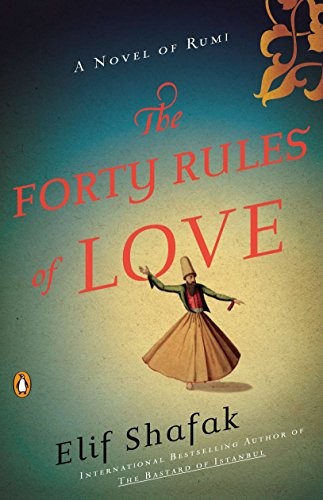
The Forty Rules of Love
Elif Shafak · b. 1971 · Turkey / UK
Why it matters
A bored Massachusetts housewife's manuscript assignment draws her into the 13th-century friendship of the poet Rumi and the wandering dervish Shams of Tabriz. Shafak's bestseller braids mystic Sufi parable with a quietly unraveling contemporary life.
At a glance
Dual timelines in clear, accessible prose; the challenge lies in its interwoven Sufi parables, not the syntax.
Deep dive
A bored suburban Massachusetts wife takes a manuscript-reading job that lands her inside the thirteenth-century friendship between the poet Rumi and a wandering dervish named Shams, and finds her own carefully arranged life dismantled by a book she was only supposed to evaluate.
Written for readers who have finished the book. No plot recap, and nothing here is safe to read first.
Themes & symbolism
Ella Rubinstein, forty and unhappily married in Northampton, takes a job as a manuscript reader for a literary agency and is assigned Sweet Blasphemy, a novel written by a mysterious author named Aziz Zahara about the historical friendship between the Sufi mystic Shams of Tabriz and the scholar-poet Jalal ad-Din Rumi. Shafak splits the book cleanly between Ella's contemporary correspondence with Aziz, which develops from professional notes into something closer to devotion, and long stretches of Sweet Blasphemy itself, so that a reader of The Forty Rules of Love is, structurally, doing exactly what Ella is doing: reading a book about spiritual transformation and slowly discovering it is happening to them too.
The thirteenth-century half of the novel tracks Shams's arrival in Konya and his effect on Rumi, at that point a respected but conventional religious scholar, whom Shams draws out of legalistic piety and into the ecstatic, boundary-breaking mysticism that would eventually produce the Masnavi and the Divan-i Shams-i Tabrizi. Shafak stages that transformation as dangerous rather than purely inspiring: Rumi's devoted students, and especially his son Aladdin, experience Shams's closeness to their teacher as an intrusion, one edged with a jealousy the novel never resolves into simple explanation, whether it is theological offense, wounded pride, or something closer to romantic possessiveness.
Shafak threads forty numbered rules of love through Shams's sections, aphorisms on surrender, presence, and the dissolving of the self that read, deliberately, like instructions Ella could apply directly to her own stalled marriage, and the novel's central wager is that this kind of wisdom survives translation across eight centuries largely unchanged: what unsettles Rumi's Konya is recognizably the same thing unsettling Ella's Northampton, a life organized entirely around safety rather than presence.
What Kind of Love Was This
Shafak leaves deliberately open a question historians of Rumi and Shams have argued over for centuries: whether their bond was purely spiritual, a teacher-disciple relationship of the kind Sufi tradition has many records of, or carried an erotic charge that later, more conservative retellings scrubbed out of the record. Sweet Blasphemy lets both readings coexist without forcing a verdict, treating the ambiguity itself as true to a friendship intense enough to scandalize Rumi's own household and devoted enough to survive Shams's death in Rumi's poetry for the rest of his life, which is closer, Shafak implies, to how such love has actually always resisted tidy categories.
The last seal: what actually happens, and why it lands the way it does.
The ending, explained
Aladdin and a group of Rumi's threatened disciples arrange for Shams to be killed, his body left in a well, ending the relationship that had scandalized Konya rather than letting it simply fade. Rumi's grief does not silence him, it converts him fully into the poet history remembers, the loss of Shams becoming the wound his most famous verse writes directly out of. In the present day, Ella finally leaves her marriage to join Aziz, only to learn he is dying of cancer; their time together is brief, and he dies not long after they are reunited. Shafak closes on Ella choosing to stay changed by the experience anyway, treating the shortness of what she was given as no argument against having wanted it.
Where to go next
 Elif Shafak · 2006The Bastard of IstanbulLvl 4Medium pace
 Elif Shafak · 201910 Minutes 38 Seconds in This Strange WorldLvl 5Medium pace
 Orhan Pamuk · 1998My Name Is RedLvl 7Medium pace
 Alaa Al Aswany · 2002The Yacoubian BuildingLvl 4Fast paced
 Han Kang · 2007The VegetarianLvl 6Fast paced
 Jenny Erpenbeck · 2015Go, Went, GoneLvl 5Medium pace