
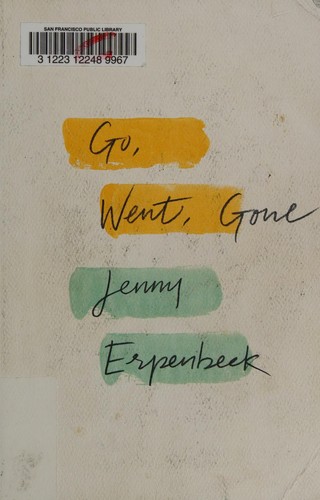
Go, Went, Gone
Jenny Erpenbeck · b. 1967 · Germany
Originally Gehen, ging, gegangen (German) · translated by Susan Bernofsky
Why it matters
A retired East Berlin classics professor grows entangled in the lives of African refugees camped in his newly reunified city. Erpenbeck turns bureaucratic indifference into the novel's real antagonist.
At a glance
Clear prose, but bureaucratic documentation is woven throughout deliberately.
Deep dive
A retired East Berlin classics professor, once a citizen of a country that dissolved overnight, starts interviewing African refugees camped in his newly reunified city — and finds his professional distance from their bureaucratic limbo harder to keep than he expected.
Written for readers who have finished the book. No plot recap, and nothing here is safe to read first.
Themes & symbolism
Erpenbeck builds her real antagonist out of paperwork: the Dublin Regulation and its Kafkaesque German administration trap the men Richard meets in a limbo where they can't legally work, can't claim asylum because they first set foot in Italy, and can't be deported either — a system that determines survival while remaining totally indifferent to the human lives it processes. Richard's own history supplies the novel's quietest, most exact parallel without ever equating the two experiences: as an East German whose entire state vanished in 1989, he too was once administratively reclassified, his citizenship and legal footing dissolved by decree rather than choice, which is precisely why he recognizes what bureaucratic non-existence costs even as he starts out treating the men as research subjects rather than people.
His scholarly specialty, Ovid's Metamorphoses, becomes an unexpectedly literal lens rather than a decorative one: a text obsessed with identity in enforced flux turns out to describe, better than any policy document could, what it means to have your whole legal and personal self a matter of shifting categories rather than settled fact. The novel's method throughout is to let Richard's academic training — interviewing, note-taking, translating — start as a way of keeping the men at a safe intellectual distance and gradually fail to do that job.
Bureaucracy as the Real Villain
Erpenbeck stages her critique almost entirely through documents and procedure rather than individual cruelty — case workers, regulations, and forms recur as the novel's true obstacles, more implacable than any character. That choice makes the book's politics land with unusual precision: there is no single villain to defeat, only a system that nobody inside it, refugee or bureaucrat, seems able to see whole.
Two Germanys, One Indifference
Erpenbeck, who grew up in East Berlin before reunification, gives Richard a biography close to her own generation's, and uses his memory of one German state's overnight dissolution to needle at reunified Germany's confidence that its current order is simply how things are. The men Richard meets are stuck in exactly the kind of administrative non-status his own country's citizens briefly occupied in 1990 — proof, in the novel's quiet argument, that statelessness isn't a foreign problem happening to foreign people, just one Germany has already lived through once and preferred to forget.
The last seal: what actually happens, and why it lands the way it does.
The ending, explained
Nothing about the asylum system itself gets fixed — the Dublin Regulation remains as indifferent at the novel's close as at its start, and Richard's efforts change no policy. What does change is Richard: he opens his own home to several of the men, builds lasting friendships across the gulf of language and legal status that once separated researcher from subject, and the book ends on a scene of shared domestic life at his table, a small, deliberately modest answer set against the cold machinery the rest of the novel has documented — personal solidarity offered as the only remedy literature can actually deliver.
Where to go next
 Jenny Erpenbeck · 2021KairosLvl 6Medium pace
 W. G. Sebald · 1995The Rings of SaturnLvl 7Slow burn
 Elfriede Jelinek · 1983The Piano TeacherLvl 7Slow burn
 Peter Handke · 1972A Sorrow Beyond DreamsLvl 6Slow burn
 Kazuo Ishiguro · 1989The Remains of the DayLvl 5Slow burn
 Elias Canetti · 1935Auto-da-FéLvl 7Slow burn