
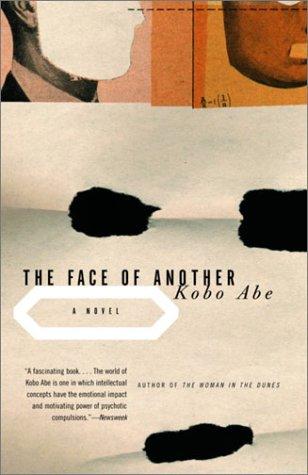
The Face of Another
Kōbō Abe · 1924–1993 · Japan
Originally Tanin no Kao (Japanese) · translated by E. Dale Saunders
Why it matters
A scientist disfigured in an accident builds a lifelike mask and uses it to seduce his own wife. Abe's chilling parable of identity and alienation: the self as nothing more than the surface others see.
At a glance
Notebook-form narration and abstract philosophical digression on identity.
Deep dive
A scientist disfigured beyond recognition builds a mask flawless enough to fool his own wife, then treats his marriage as the experiment that will finally prove what a face is actually for.
Written for readers who have finished the book. No plot recap, and nothing here is safe to read first.
Themes & symbolism
Abe's narrator, an engineer left with a mass of keloid scarring after a liquid-oxygen accident in his own lab, writes three notebooks addressed to "you," his wife, and treats the writing itself as evidence in a case he's building against her. Rather than accept the reconstructive surgery his disfigurement would normally call for, he spends months perfecting a mask indistinguishable from living skin, then rents a separate apartment under a false name and sets himself a single experiment: seduce his own wife as a stranger, and use whatever happens as proof that a face, not a self, is what a marriage actually rests on. The premise reads at first like science fiction's usual trick of making a metaphor literal, but Abe keeps the mask's mechanics, the wax mold, the matched skin tone, the daily maintenance of pores and stubble, so exact that the philosophy never gets to hide behind vagueness; every claim the narrator makes about identity has to survive contact with an actual manufactured object.
A second, unrelated plot keeps intruding on the main one: a film the narrator watches obsessively about a young woman disfigured on one side of her face by the Nagasaki bombing, whose own fiancé recoils once he sees the scarring beneath her makeup. Abe never explains why he interleaves this footage with the mask experiment, and that's the point. The narrator reads his private, accidental wound as continuous with a national, historical one, and the two never actually line up: her scarring came from a weapon that disfigured an entire city at once and asked nothing of the people it marked, while his came from his own laboratory and asks him, specifically, whether he can still be loved once he engineers a way around it. Abe lets that gap between the two woundings stand unresolved, a quiet rebuke to how easily the narrator borrows the graver history to dignify his own self-pity.
The Notebook as Instrument, Not Confession
The three notebooks are less a diary than a lab report kept by a jealous man: the narrator footnotes his own reasoning with a private theory of the face as social membrane rather than biological given, and keeps circling a claim he never quite proves, that the mask hasn't changed who he is so much as revealed who he secretly always was. Abe trained as a physician before he became a novelist, and the prose carries that training's clinical patience, recording the narrator's escalating manipulation of his own wife in the same flat register he uses for the mask's cheek pigment. He never once notices that his methodology has stopped being a study of identity and become an alibi for stalking his own marriage.
The last seal: what actually happens, and why it lands the way it does.
The ending, explained
The narrator leaves the notebooks where his wife will find them, in effect confessing the entire scheme in writing rather than aloud, and the book's final section is her letter back to him. She tells him she recognized her own husband under the mask from their very first meeting as strangers, and let the deception run its course anyway, guessing that he needed the disguise to say things to her that his own face had stopped letting him say. Proving a mask could turn him into a stranger told the narrator nothing he wanted to know: the one recognition that might have mattered, hers, was never actually in doubt, and Abe closes on the narrator adrift in the city behind his mask, raging at a stranger who may be no one but his own reflection.
Where to go next
 Kōbō Abe · 1962The Woman in the DunesLvl 5Medium pace
 Yōko Ogawa · 1994The Memory PoliceLvl 4Slow burn
 Franz Kafka · 1915The MetamorphosisLvl 4Medium pace
 Endō Shūsaku · 1966SilenceLvl 5Slow burn
 Yukio Mishima · 1956The Temple of the Golden PavilionLvl 6Slow burn
 Kenzaburō Ōe · 1964A Personal MatterLvl 5Medium pace