
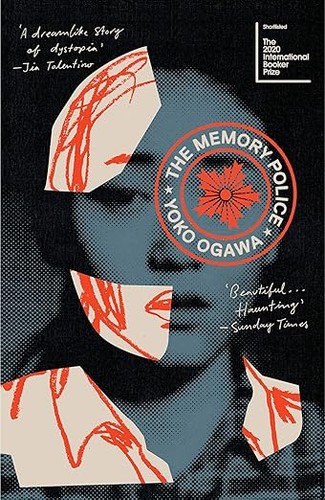
The Memory Police
Yōko Ogawa · b. 1962 · Japan
Originally Hisoyaka na Kesshō (Japanese) · translated by Stephen Snyder
Why it matters
On an island where objects vanish by decree along with all memory of them, those who still remember are hunted. Ogawa turns loss into a soft, encroaching horror: a fable of authoritarianism, grief, and disappearance.
At a glance
Calm, controlled prose despite the unsettling premise; a smooth, linear read.
Deep dive
Why the novel's real horror isn't the vanishing objects but the vanishing vocabulary for missing them — and what it means that only one man on the island is left to grieve on everyone else's behalf.
Written for readers who have finished the book. No plot recap, and nothing here is safe to read first.
Themes & symbolism
Ogawa's disappearances work by erasing the concept before the object matters: residents don't wake up banned from ribbons, they wake up unable to care that ribbons ever existed, so there's no mourning and no resistance, only a mild bafflement at objects they're told to discard or burn. That's the novel's real subject — an authoritarianism that needs no force once it controls memory, because a population that can't remember what it lost can't organize around the loss. The horror stays procedural and communal: neighbors quietly burning photographs together, birds released into a colorless sky, all without anguish, because anguish requires a memory of what a bird was for in the first place.
The narrator's own unfinished novel, about a typing student who loses her voice, runs beneath the main plot as a diagram of what's happening to her — body and memory collapse into the same thing as the disappearances progress. R, immune to the erasures, becomes the island's only actual archive, not a rebel so much as a repository, sheltered in a floor cavity like a physical metaphor for memory driven underground and kept alive in secret. His fixed, unchanging body set against the narrator's increasing incorporeality frames memory as something that has to be housed somewhere, in someone, or it simply stops existing at all.
The novel inside the novel
The narrator's manuscript, in which a controlling typing teacher steals a student's voice and locks her in a tower of clocks, isn't ornamental — it's the clearest statement of theme in the book, dramatizing captivity and stolen expression months before the narrator herself loses her own voice and hides in a room of her own. Ogawa lets the interior story grow more explicit as the outer story grows stranger, so fiction becomes the one place the narrator can name what's happening to her before it actually happens to her body.
The Memory Police as bureaucracy, not spectacle
The Police are never given an ideology, a slogan, or a face — they search houses with clipboards and apologize as they confiscate. Ogawa refuses the genre's usual villain theatrics because the point is that the machinery runs on procedure rather than belief; officers who disappear people are themselves subject to the same disappearances, unable to recall days later what they were even searching for. That's why the book reads as fable rather than conventional dystopia — there's no ideology left to argue with, only a process everyone, hunters included, has already submitted to.
The escalating scale of what disappears — from small, almost decorative objects like ribbons and stamps toward calendars, novels, and finally body parts — traces a deliberate arc from the merely sentimental to the existential, so the reader's own sense of what counts as a devastating loss keeps having to be revised upward. Ogawa's flat, unhurried prose never spikes into horror-movie register even as the stakes do, which is itself part of the argument: catastrophe that arrives as routine doesn't feel like catastrophe to the people living through it, only to the reader outside the fiction who still remembers what a ribbon is.
The last seal: what actually happens, and why it lands the way it does.
The ending, explained
By the final chapters the disappearances have turned on the body itself: legs, then arms, vanish from the collective world along with any memory that they existed, leaving the narrator's voice as the last thing tethering her to presence. Ogawa refuses a rescue or any reveal of what the Police actually want; the novel closes with the narrator nearly gone and R still intact below the floorboards, the one person left who will go on remembering a woman, an island, and a whole vocabulary of lost objects that no one still standing is even capable of missing. It's an ending that offers witness instead of resolution — the loss doesn't get undone, it just gets held by someone.
Where to go next
 Yōko Ogawa · 2003The Housekeeper and the ProfessorLvl 2Slow burn
 Kōbō Abe · 1962The Woman in the DunesLvl 5Medium pace
 Banana Yoshimoto · 1988KitchenLvl 2Medium pace
 Mieko Kawakami · 2019Breasts and EggsLvl 4Slow burn
 Sayaka Murata · 2016Convenience Store WomanLvl 2Fast paced
 Haruki Murakami · 1987Norwegian WoodLvl 3Fast paced