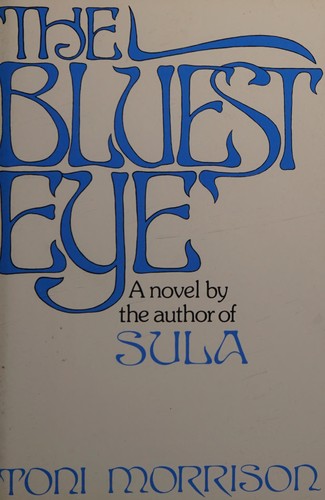
The Bluest Eye
Toni Morrison · 1931–2019 · USA
Why it matters
A Black girl in Lorain, Ohio prays for blue eyes: beauty standards as slow violence. Morrison's first novel announced the project: the interior lives American fiction had refused to imagine, written from inside.
At a glance
Shifting narrators and fragmented chronology carry unflinching, dense material.
Deep dive
What the Dick and Jane primer text is doing at the top of every section, increasingly stripped of punctuation and then of spaces entirely, and why Claudia MacTeer keeps circling back to a row of marigolds that never bloomed.
Written for readers who have finished the book. No plot recap, and nothing here is safe to read first.
Themes & symbolism
Morrison opens with the Dick-and-Jane primer in full, then repeats it twice more with degrading typography, first without punctuation, then run together with no spaces at all. The primer's idealized white nuclear family, green-and-white house, laughing Mother, a Father who is big and strong, functions as the template American culture hands every child for what family, home, and beauty are supposed to look like, and its collapsing typography enacts, visually, what happens when Black poverty is measured against a script that was never built to hold it.
Pecola Breedlove's prayer for blue eyes is that primer's logic carried to its most literal, devastating conclusion: she has absorbed completely that being seen as beautiful, meaning white, is a precondition for being loved or even safely looked at. Morrison surrounds her with adults who have made smaller versions of the same trade, her mother Pauline finding order and beauty only at the movies and in the pristine white household she keeps as a domestic worker, openly favoring that family's daughter over her own children at home.
Claudia's Marigolds and the Guilt of the Witnesses
Claudia and her sister plant marigold seeds the year Pecola is pregnant, half-believing the flowers' growth might somehow protect the baby, and the seeds' failure to sprout becomes the adult Claudia's central image for the whole community's failure, not Cholly's alone, to make conditions Pecola could survive in. Claudia's retrospective narration reads less like innocent childhood memory than overdue witnessing, an adult finally saying what the child couldn't yet name.
Soaphead Church's Cheap, Effective Miracle
Soaphead Church, a fraudulent spiritualist who reads dreams and sells charms, is the only person in the novel who gives Pecola exactly what she asks for, tricking her into poisoning a neighbor's dog and letting her believe the act has earned her blue eyes. His fraud is a mercy only in the sense that the rest of the town's cruelty has already been, which is Morrison's real point: no single villain did this to Pecola, an entire community's small failures did. Morrison gives Soaphead his own letter to God near the book's close, a confession that reads as self-justifying and genuinely wounded at once, refusing the reader an easy verdict on a man who is both predator and, by his own lights, the one person in Lorain willing to grant a Black child's wish.
The last seal: what actually happens, and why it lands the way it does.
The ending, explained
Cholly rapes Pecola in the kitchen, a scene Morrison narrates by reaching, unsentimentally, for whatever warped tenderness is left in him rather than reducing him to pure monster. Pecola is impregnated; the baby is born prematurely and dies, and her mind splits under the weight of it, coming to believe Soaphead's trick actually worked. She spends the novel's final pages walking the edges of town in conversation with an invented friend, the only listener left willing to confirm that her eyes are now the bluest of anyone's. Claudia's closing lines state outright what the marigolds already implied: some ground is simply too hostile for anything to grow in, regardless of what gets planted there.