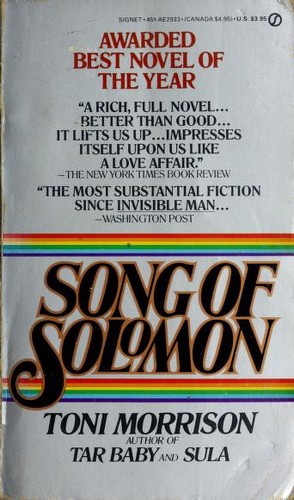
Song of Solomon
Toni Morrison · 1931–2019 · USA
Why it matters
Milkman Dead follows a folk song south into his family's buried history: flight as inheritance. The novel that made Morrison's national name; Obama gave it a presidential medal citation of its own.
At a glance
Folkloric symbolism and a nonlinear genealogical structure require close attention.
Deep dive
Milkman Dead goes south chasing a bag of gold and finds instead the family names, songs, and one unbelievable flight story that actually explain who he is.
Written for readers who have finished the book. No plot recap, and nothing here is safe to read first.
Themes & symbolism
Names in this novel are simultaneously wounds and acts of authorship. Macon Dead I's surname descends from a drunk Freedmen's Bureau clerk who filled out his registration papers wrong, erasing the family's actual name and replacing it with a bureaucratic error the family then carries for three generations. Pilate's name, by contrast, was chosen by her illiterate father at random from a Bible page, and she wears it literally, folded into a brass snuffbox worn as an earring, turning an imposed word into a talisman she controls. Streets renamed by the Black community itself, Not Doctor Street, Mercy renamed No Mercy Hospital, show the same instinct at communal scale: reclaiming language the white town tried to fix in place.
Flight is the novel's other controlling image, introduced in the opening scene with an insurance agent's doomed leap from a hospital roof, advertised in advance on a handbill, and developed fully through the buried family legend of Solomon, Milkman's great-grandfather, said to have flown back to Africa and left behind a wife, Ryna, and twenty-one children. Morrison treats flight as the ultimate fantasy of Black freedom, escaping bondage bodily rather than merely surviving it, and simultaneously as a form of abandonment, since every flight in the book leaves someone grounded, grieving, and often literally screaming, the way Ryna's ravine is said to still echo with her cries. The novel never fully separates those two readings, and it isn't supposed to.
A Name for Every Generation
Milkman's own nickname, earned because his mother Ruth nursed him well past infancy, is gossip turned identity, a private family shame made permanent and public. His sisters, First Corinthians and Magdalene, called Lena, carry names borrowed wholesale from the Bible with none of Pilate's deliberate ownership over hers, names picked by a father who wanted respectability rather than meaning. Guitar's actual surname, Bains, is barely used at all, the nickname from his childhood obsession with a guitar he never actually learns to play sticking harder than his given name ever does. Morrison lets the pattern accumulate until naming itself becomes a kind of family history, who chose the name, why, and what got erased to make room for it.
The Seven Days and the Politics of Vengeance
Guitar belongs to a secret society called the Seven Days, which answers every extrajudicial killing of a Black person with the ritual murder of a white person, an act of exact retributive arithmetic carried out with cold, principled precision rather than rage. Morrison sets Guitar's disciplined, murderous logic directly against Milkman's long detachment from racial politics, his self-absorption reading, for most of the book, as its own kind of moral failure next to Guitar's terrible clarity. Neither position is offered as simply right, and the widening gap between the two childhood friends becomes the novel's clearest measure of how differently Black manhood can respond to the same inherited violence.
The last seal: what actually happens, and why it lands the way it does.
The ending, explained
Milkman's journey south, first to Danville, Pennsylvania, then to Shalimar, Virginia, uncovers the Solomon legend as more than folklore: it's his own family history, a song the local children still sing without knowing whose story it tells. He returns north with Pilate to properly bury her father's bones at the ridge locally called Solomon's Leap, and there Guitar, who has spent the novel's second half stalking Milkman over a misunderstanding about gold, shoots at him and kills Pilate instead, who dies in Milkman's arms asking to hear a bird sing one more time. Morrison closes on Milkman launching himself off the ridge toward Guitar, the narration folding Solomon's flight myth directly into the moment: 'if you surrendered to the air, you could ride it.' Whether that's triumphant flight, a surrender to the family myth, or simply Milkman meeting Guitar in midair with nothing decided, the novel refuses to specify, ending on the same ambiguity between escape and abandonment that flight has carried from the first page.