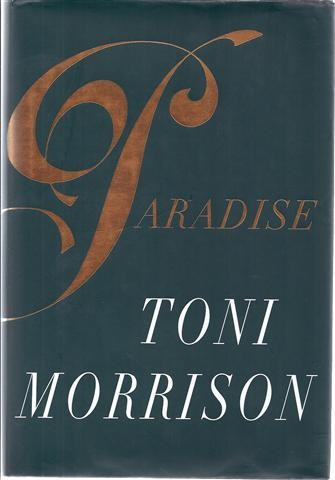
Paradise
Toni Morrison · 1931–2019 · USA
Why it matters
An all-Black Oklahoma town's men raid a nearby refuge of troubled women, certain they're protecting their utopia from corruption. Morrison's 'They shot the white girl first' opens a novel about who gets to build paradise, and who gets purged to keep it pure.
At a glance
A large ensemble cast and a structure that withholds and scrambles key facts resist easy tracking.
Deep dive
Why Morrison never lets you find out which of the convent women is white, and what the fight over one missing word carved into the town oven says about who Ruby was actually founded to keep out.
Written for readers who have finished the book. No plot recap, and nothing here is safe to read first.
Themes & symbolism
Ruby's founding families carry a specific, generations-deep trauma Morrison calls the Disallowing, an incident in which the original nine families, migrating west after Reconstruction, were turned away not by white towns but by lighter-skinned Black communities who judged their unusually dark skin beneath them, and Ruby is built afterward as a fortress against ever being rejected on those terms again, a purity of blackness enforced as rigidly as the whiteness it's answering. Morrison's famous opening line, 'They shot the white girl first,' and the deliberate refusal to ever specify which of the convent's women is white, forces the reader into the same reflex the men of Ruby are acting on, trying to sort the women by race before judging them by anything else about who they actually are.
The convent nearby, a former Catholic school turned refuge run by Consolata, an Afro-Brazilian woman raised and trained by a nun, has become home to a handful of women fleeing abusive husbands, dead children, and other unrepairable griefs, women Ruby's men have decided, without much direct evidence, are responsible for the town's recent run of domestic troubles, miscarriages, failed marriages, restless children. Morrison builds the massacre less as spontaneous violence than as the logical outcome of a closed community that has spent generations defining its own goodness against an outside it needs to keep believing is corrupt, the same defensive purity that founded the town in the first place turning, finally, lethal.
The Oven's Missing Word
The town's founding families transported an iron communal oven from their previous failed settlement and inscribed it with a phrase, 'Be the Furrow of His Brow,' whose first word has worn away, and Ruby's younger generation reads the missing word as an instruction, 'Beware the Furrow of His Brow,' God's judgment to be feared, while the older generation insists on the original, 'Be the Furrow,' an instruction to embody God's will rather than fear it. Morrison uses the argument, staged repeatedly at town meetings, as a proxy for the town's actual crisis: a founding generation demanding unquestioning reverence for the original vision, and a younger one asking whether that vision was ever as righteous as its founders claimed.
The last seal: what actually happens, and why it lands the way it does.
The ending, explained
A group of Ruby's men, led by the town's twin patriarchs Deacon and Steward Morgan, raid the convent armed, and in the chaos that follows several of the women are shot, though Morrison keeps the actual body count and the women's fates deliberately unresolved, since a subsequent town search of the convent finds no bodies at all. In the novel's closing pages, several of the presumed-dead women appear, alive or ghostly, visiting family members who mourned them, an ambiguous afterlife Morrison offers without explaining whether it's literal, spiritual, or simply the survivors' own need to believe the women escaped. The massacre Ruby staged to protect its own paradise produces no clean resolution, only a town left to live with an act of violence it can neither fully account for nor take back.