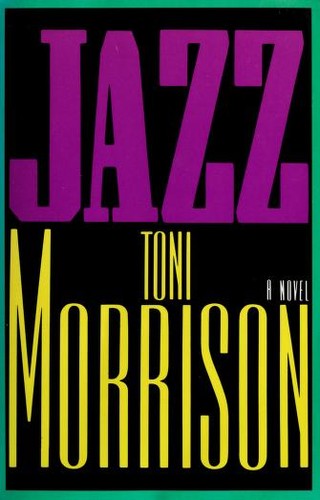
Jazz
Toni Morrison · 1931–2019 · USA
Why it matters
A Harlem husband shoots his teenage lover, and his wife attacks the corpse at the funeral: a love triangle Morrison narrates like a jazz solo, circling back to improvise on its own plot. The Great Migration's interior life, set to the music of the 1920s.
At a glance
A self-revising, improvisatory narrator deliberately scrambles chronology and reliability.
Deep dive
How the same triangle of husband, wife, and a dead girl gets replayed and revised as the narration circles back on itself, and what Morrison means by giving the story's voice something closer to a conscience than a plot to follow.
Written for readers who have finished the book. No plot recap, and nothing here is safe to read first.
Themes & symbolism
Joe Trace, a door-to-door salesman in his fifties, begins an affair with eighteen-year-old Dorcas that ends when he shoots her rather than accept that she has moved on to a younger man, and Morrison's narrator, unusually self-conscious and city-voiced, tells this story more than once, correcting and revising its own account the way a jazz solo returns to a theme and plays it differently each time. The structure isn't decoration. Morrison is arguing that a single true version of what happened between Joe, Violet, and Dorcas doesn't exist, only successive, improvised attempts to get closer to it, which is also what grief does to memory.
Violet's response to her husband's affair and the girl's death is to attack Dorcas's corpse with a knife at the girl's own funeral, trying to disfigure a face she associates with everything her marriage has failed to give her, an act the Harlem community reads as scandal but the novel reads as a woman finally directing outward a violence she has spent her whole adult life turning against herself. Morrison ties Violet's breakdown to a specific inherited wound: her grandmother True Belle raised a light-skinned boy named Golden Gray in preference to darker children, planting in Violet a lifelong, corrosive belief that lighter skin and youth are simply worth more, a belief Dorcas's youth reactivates in Joe as well as in Violet.
Wild in the Cane and the Novel's Unclaimed Mother
Golden Gray's search for his absent Black father leads him to a feral, possibly deranged woman living wild in the Virginia canebrakes, a woman the novel leaves permanently unidentified but strongly implies is Joe Trace's actual mother, meaning Joe has spent his life not knowing whose son he is in the same structural way Dorcas's death leaves him not knowing, finally, who he's become. Morrison keeps Wild just barely offstage and just barely explained, a suppressed rural history of the Great Migration's generation that the city narrative can gesture toward but never fully retrieve, the rural South's unfinished business trailing every family that thought Harlem was a clean break from it.
The last seal: what actually happens, and why it lands the way it does.
The ending, explained
Joe and Violet, rather than separating after the affair, the murder, and the funeral attack, slowly rebuild a version of their marriage around the wreckage, taking in Dorcas's friend Felice as something like a daughter figure and settling into a quieter, harder-won intimacy than either had before Dorcas ever entered their lives. The narrator, who has spent the novel confidently predicting and revising the characters' behavior, admits by the end to having been wrong about them, to having underestimated their capacity to choose each other again, and closes the book addressing the reader directly, asking to be remade, loved, in the same improvisational way its own characters finally manage to love each other.