
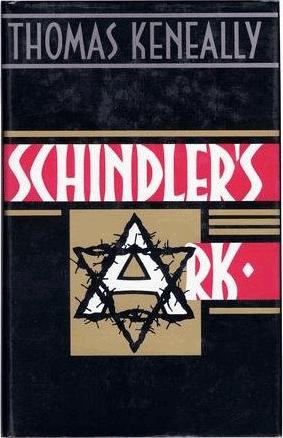
Schindler's Ark
Thomas Keneally · b. 1935 · Australia
Why it matters
A womanizing, war-profiteering German industrialist gradually risks everything to save over a thousand Jewish workers from Auschwitz. Built from survivor testimony, Keneally's Booker winner blurs documentary and novel so thoroughly the judges nearly disqualified it.
At a glance
Clear chronological narrative, though its documentary density and huge cast reward patience.
Deep dive
A book that refuses to locate the single moment its profiteering hero became a savior, because Keneally's real subject is how documentary fact resists that kind of narrative tidiness.
Written for readers who have finished the book. No plot recap, and nothing here is safe to read first.
Themes & symbolism
Keneally deliberately withholds a conversion scene. Schindler drinks, philanders, and profits from slave labor in the same months he's bribing SS officers to keep his workers off the trains, and the book never resolves whether decency or vanity or sheer contrarian nerve drives him — it simply accumulates the evidence and declines to psychoanalyze it away. That refusal is the novel's central argument: virtue under totalitarianism doesn't arrive as an epiphany, it arrives as a thousand small, self-interested, courageous decisions made by a deeply compromised man, and demanding a cleaner hero would falsify what actually happened.
The factory itself becomes the book's central image — Emalia's enamelware and later the Brünnlitz munitions plant are simultaneously a cover story, a genuine haven, and a swindle Schindler runs against the Reich, its deliberately mis-calibrated shells a small, sustained act of sabotage dressed as production. The list of workers' names, typed and retyped, forged and re-forged, becomes something closer to scripture than payroll: the one bureaucratic document in the whole apparatus of the Holocaust whose purpose is preservation rather than destruction.
Keneally is careful, too, to keep the surrounding machinery of the Holocaust in frame rather than letting Schindler's story stand in for the whole of it — Amon Göth's casual, recreational sadism at Płaszów is given full weight precisely so that Schindler's bribery and string-pulling read as what they were: exceptions inside an otherwise near-total system, not evidence that decency could have scaled if only more people had tried.
A novel that argued it wasn't one
Keneally built the book from years of interviews with survivors — Poldek Pfefferberg chief among them — plus depositions, letters, and archival paperwork, presenting real testimony inside novelistic scene-setting and reconstructed dialogue. That hybrid form nearly got it disqualified from the 1982 Booker Prize on the grounds that it wasn't fiction at all, a controversy the book's method invites: Keneally isn't dramatizing history for effect so much as refusing the false choice between the accuracy of a document and the intimacy of a novel, letting neither genre fully claim it.
The last seal: what actually happens, and why it lands the way it does.
The ending, explained
As the war ends, Schindler — now bankrupt, having spent his fortune on bribes and black-market supplies to keep his workers fed and off the trains — flees west to avoid capture as a Nazi party member and war profiteer. His workers draft a letter testifying to what he'd done and give him a ring made from a prisoner's gold tooth, inscribed with the Talmudic line that whoever saves one life saves the world entire. Schindler lives out the rest of his life in relative poverty and obscurity between Germany and Argentina, later named Righteous Among the Nations and buried, at his request, in Jerusalem — the ending pointedly denies him any postwar triumph, matching the book's refusal to let his story become a simple redemption arc.
Where to go next
 Richard Flanagan · 2013The Narrow Road to the Deep NorthLvl 6Medium pace
 Hugo Claus · 1983The Sorrow of BelgiumLvl 6Medium pace
 Peter Carey · 1988Oscar and LucindaLvl 6Medium pace
 J. M. G. Le Clézio · 1980DesertLvl 5Slow burn
 Geraldine Brooks · 2005MarchLvl 5Medium pace
 Charles Frazier · 1997Cold MountainLvl 4Medium pace