
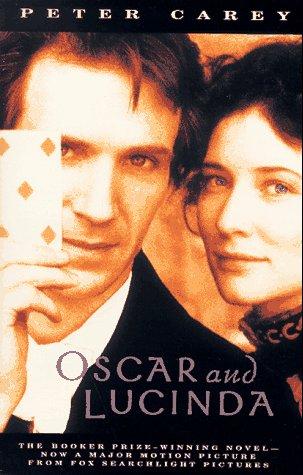
Oscar and Lucinda
Peter Carey · b. 1943 · Australia / United States
Why it matters
A gambling-addicted clergyman and a headstrong glass-factory heiress bet everything on hauling a crystal church into the outback. Carey's Booker winner turns Victorian romance and colonial ambition into something stranger and sadder than either.
At a glance
Ornate, digressive prose and dual timelines require patience despite a driving plot.
Deep dive
A love story between two gambling addicts that turns religious faith itself into a wager, staged around a glass church carried across a continent as the ultimate bet.
Written for readers who have finished the book. No plot recap, and nothing here is safe to read first.
Themes & symbolism
Glass is the novel's controlling image for everything Oscar and Lucinda are: transparent, fragile, capable of throwing off astonishing light and shattering at a touch. Lucinda's factory produces the stuff commercially, but for both of them it's really a metaphor for faith and for feeling — visible, beautiful, structurally unable to survive contact with the world. Oscar's gambling is explicitly theological, a Pascal's-wager logic he's carried since childhood: if belief is itself a bet against uncertain odds, then betting on horses or cards is simply a more honest version of the same act, stripped of the church's pretense that faith is anything but risk.
Carey uses the glass church's overland journey to fuse the couple's private wager with the novel's public one — the violent colonization of the Australian interior. Jeffris, the expedition's leader, is exactly the kind of ruthless competence Oscar's faith has no answer for, and his campaign of massacre against Aboriginal people along the route happens in full view of a horrified, paralyzed Oscar, who funds and enables the journey without ever intending its cruelty. The novel refuses to let the love story and the colonial violence stay separate: the wager that proves Oscar's love for Lucinda is the same expedition that commits atrocity, and the glass church that should embody grace arrives soaked in it.
Oscar's clerical vocation is itself a kind of long-running bet he keeps doubling down on rather than a settled conviction — every crisis of faith resolves not into certainty but into a fresh wager, which is why gambling never reads in this novel as a vice competing with religion so much as religion's own logic taken to its most honest, most ruinous conclusion.
A marriage that never happens
Oscar and Lucinda's bond is built entirely out of things other people would consider ruinous — shared shame, shared addiction, long nights at the tables — and Carey deliberately withholds the marriage plot their story keeps gesturing toward. Lucinda stakes her entire fortune on Oscar completing the delivery essentially as a declaration of love in the only language they share, risk; by the time the wager resolves, whatever the outcome, she's already lost everything a conventional ending would have preserved for her.
The last seal: what actually happens, and why it lands the way it does.
The ending, explained
Terrified of water his whole life, Oscar is tied to the glass church for its final leg down the river to Boat Harbour — the one form of exposure his faith has always demanded he accept rather than flee. The vessel capsizes; the church shatters, and Oscar drowns still bound to it, the wager literalized as a coffin. Lucinda, having already staked her fortune on his completing the journey, is ruined financially whether he succeeds or not, and Carey lets the church's destruction stand as the truest outcome of a faith built on transparency and risk: it was never going to survive arrival.
Where to go next
 Peter Carey · 2000True History of the Kelly GangLvl 6Fast paced
 Gabriel García Márquez · 1967One Hundred Years of SolitudeLvl 6Medium pace
 Toni Morrison · 1987BelovedLvl 8Slow burn
 William Faulkner · 1930As I Lay DyingLvl 9Medium pace
 Joyce Carol Oates · 1969themLvl 6Medium pace
 Salman Rushdie · 1981Midnight's ChildrenLvl 8Medium pace