
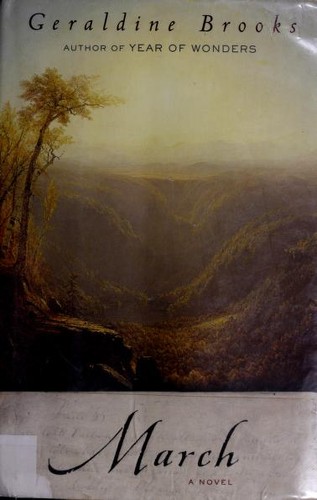
March
Geraldine Brooks · b. 1955 · Australia
Why it matters
Louisa May Alcott's Little Women sent its father figure off to war and never followed him there; Brooks does, imagining his Civil War service as Union chaplain confronting slavery and carnage his family never saw. A Pulitzer winner that fills in a beloved novel's carefully avoided horror.
At a glance
Alternating timeline and unflinching war content sit within otherwise clear, controlled prose.
Deep dive
The novel's real reckoning isn't with the war — it's with what March's wife discovers about him once she's finally allowed inside his head.
Written for readers who have finished the book. No plot recap, and nothing here is safe to read first.
Themes & symbolism
Brooks sends March's transcendentalist idealism directly into collision with the war's actual machinery, and the novel's sharpest irony is that the worst disillusionment doesn't come from Confederate violence but from the Union side: the 'contraband' cotton plantations where freed people work under conditions barely distinguishable from the slavery March enlisted to end, run by Northern speculators indifferent to the cause he thought he was serving. His crisis isn't a loss of faith in abolition but a loss of faith in the institutions supposedly enacting it — the discovery that principle survives contact with reality far worse than cowardice does.
The novel's structural pivot — handing the second half to Marmee once March falls ill — does the same work to Little Women's beloved mother that the first half does to its absent father: Brooks gives her the anger, appetite, and moral complexity Alcott's original sanded down into wholesome patience, and lets her arrive at a hospital bedside to discover not just a wounded husband but a man whose wartime conduct and a documented past with Grace Clement complicate everything she thought she knew about their marriage. Alcott's March family survives Little Women intact and grateful; Brooks's version survives only by both spouses absorbing information about each other that a more genteel novel would have suppressed. Marmee's own suppressed anger — at being left to raise four daughters alone on principle rather than necessity — is treated by Brooks as just as real a casualty of March's idealism as anything he witnesses at the front.
Alcott's Father, Revised
Brooks draws visibly on the real Bronson Alcott — Louisa May's own father, a transcendentalist reformer and sometime associate of Emerson and Thoreau whose idealism could shade into impracticality and self-regard — to give the fictional March a specific intellectual lineage rather than a generic period conscience. The gambit lets the novel critique a real strain of nineteenth-century abolitionist idealism, high-minded and articulate but not always equal to the war's actual demands, through a character readers already associate with a beloved, gentler fictional father.
Grace Clement
March's earlier relationship with Grace, an enslaved woman he knew as a young peddler before the war, is the novel's most morally load-bearing invention: it means March's abolitionism isn't abstract principle arriving untested, but a conviction shadowed by his own documented failure to act as decisively, or as honorably, as his later rhetoric claims. Marmee's discovery of this history is what actually tests the marriage — not his wounds, but the gap between the man he's presented himself as and the man the record shows.
The last seal: what actually happens, and why it lands the way it does.
The ending, explained
March survives the illness that's as much moral collapse as physical wound, and Marmee, having nursed him through it and absorbed the harder truths about his past and his conduct in the war, brings him home to a marriage that closes the novel altered rather than restored. Brooks resists both a redemptive ending, in which March's suffering earns him forgiveness, and a punitive one, in which Marmee's disillusionment ends the marriage; instead the two arrive at something more adult than the union Little Women depicted — affection intact, illusions gone. The war has stripped March's comfortable idealism without replacing it with despair, leaving a chastened, harder-won hope in its place.
Where to go next
 Thomas Keneally · 1982Schindler's ArkLvl 4Fast paced
 Jayne Anne Phillips · 2023Night WatchLvl 6Slow burn
 Charles Frazier · 1997Cold MountainLvl 4Medium pace
 Lily Tuck · 2004The News from ParaguayLvl 6Medium pace
 Anthony Doerr · 2014All the Light We Cannot SeeLvl 4Fast paced
 Richard Flanagan · 2013The Narrow Road to the Deep NorthLvl 6Medium pace