
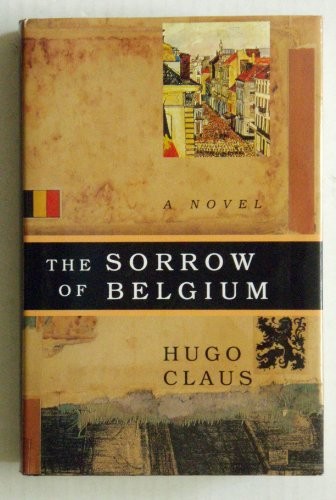
The Sorrow of Belgium
Hugo Claus · 1929–2008 · Belgium
Originally Het verdriet van België (Dutch)
Why it matters
Young Louis Seynaeve comes of age in a Flemish family swept up in enthusiasm for Nazi occupation, collaboration arriving not as villainy but as ordinary, plausible seduction. Claus's autobiographical masterpiece remains Belgium's essential reckoning with its own wartime complicity.
At a glance
A sprawling family canvas and a child's shifting perspective demand patient tracking.
Deep dive
A Flemish schoolboy's family finds itself on the enthusiastic side of a wartime occupation, and Claus is far more interested in how ordinary that enthusiasm felt from inside it than in condemning it from outside.
Written for readers who have finished the book. No plot recap, and nothing here is safe to read first.
Themes & symbolism
Claus splits the novel almost exactly at the war's midpoint: the first part, set inside a convent boarding school in 1939, gives Louis Seynaeve a child's-eye enclosure of nuns, secret clubs, and forbidden books, while the far longer second part widens out into his family's home in Walle and the German occupation itself. That structural imbalance, a short claustrophobic prelude followed by years of expanding consequence, mirrors what actually happens to Louis: the sealed, rule-bound world of the convent turns out to have trained him perfectly for a different set of rules, the Flemish nationalist and pro-German enthusiasm his own parents embrace without much internal conflict.
The title's play on Belgium's own name, in Dutch verdriet meaning both sorrow and something closer to a private grief nobody quite names, extends outward from Louis's family to the fractured, self-deceiving country itself: a Flanders resentful of French-speaking Belgian dominance finds in German occupation not a foreign imposition to endure but an opportunity some of its own people actively welcome. Claus never lets Louis's family read as monstrous outliers; their collaboration arrives dressed as cultural pride and practical opportunism, ordinary enough that the boy absorbs it as simply how the adults around him see the world, right up until the war's collapse forces a reckoning none of them are prepared for.
A Novelist Writing His Own Family's Verdict
Claus drew the Seynaeve household directly from his own, whose real members were convicted collaborators after the war, and the novel's refusal to caricature Louis's parents carries the weight of that inheritance: Claus isn't inventing sympathetic collaborators as a provocation, he's working through people he actually knew and loved regardless of what they'd done. That closeness is what gives the book its authority as Belgium's central literary reckoning with occupation, since it refuses the comfort of treating collaboration as something only other, worse families were capable of.
Louis's Own Apprentice Novel as a Warning Sign
The convent-school chapters give Louis a secret society devoted to reading forbidden books and, eventually, to writing an overwrought novel of his own, a schoolboy's imitation of adult literary ambition that Claus treats with real affection rather than mockery. That budding vocation matters beyond its comedy: it's the same appetite for grand, borrowed narrative that later lets Louis absorb his family's Flemish nationalist mythology so readily, since a boy already primed to prefer a dramatic story over an ordinary one makes an easy audience for propaganda dressed up as cultural destiny.
The last seal: what actually happens, and why it lands the way it does.
The ending, explained
Liberation arrives not as a clean moral reset but as a slow unraveling of the world Louis's childhood took for granted: collaborators are rounded up, family members face internment, and the confident Flemish nationalism that had structured his boyhood collapses into shame and silence almost overnight. Louis himself, having spent the war absorbing his family's politics and his school's discipline in roughly equal measure, comes through it less as a boy transformed by moral awakening than as one who has simply watched the adult certainties around him prove unreliable, left with little to build an identity on except the ambition to write it all down. Claus ends the novel on that unresolved inheritance, a generation's sorrow that has no single villain left to blame it on.
Where to go next
 James Joyce · 1914DublinersLvl 3Slow burn
 Harry Mulisch · 1992The Discovery of HeavenLvl 6Medium pace
 Cees Nooteboom · 1980RitualsLvl 6Slow burn
 Thomas Keneally · 1982Schindler's ArkLvl 4Fast paced
 Richard Flanagan · 2013The Narrow Road to the Deep NorthLvl 6Medium pace
 Eyvind Johnson · 1946Return to IthacaLvl 6Medium pace