
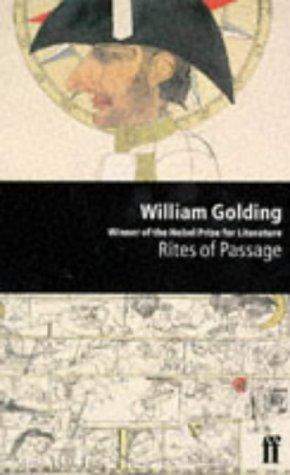
Rites of Passage
William Golding · 1911–1993 · England
Why it matters
On a warship converted for emigrants to Australia, a snobbish young gentleman's journal records the shipboard mockery closing in on an awkward, ill-suited parson. The 1980 Booker winner and the start of Golding's sea trilogy: class as a killing instrument.
At a glance
Georgian journal pastiche, nautical idiom, and crucial events glimpsed only between entries.
Deep dive
A snobbish young journal-keeper records a shipboard hazing as comedy, then a second document surfaces that shows what the joke actually cost. Golding's Booker winner puts two accounts of the same crossing side by side and dares you to trust the first one.
Written for readers who have finished the book. No plot recap, and nothing here is safe to read first.
Themes & symbolism
Talbot's journal is the novel's trap: witty, socially assured, entirely convinced of its own reliability, and — the second half reveals — catastrophically blind to what it was actually recording. His condescending amusement at Reverend Colley, an awkward, lower-berth parson who becomes the crew's favorite target, reads at first like the shipboard equivalent of class comedy, exactly the register Talbot's aristocratic confidence trains him to hear it in. Golding is doing something formally aggressive by making the reader complicit in that misreading before correcting it, since we've laughed along with Talbot's account before Colley's own letter arrives to show what the "crossing the line" ceremony actually did to him.
Colley's document reframes the entire first half as a story about power that never announces itself as violence because the people benefiting from it are having too much fun to notice. His devastation — the sexual humiliation of the ceremony, and his own drunken participation in something he cannot reconcile with his religious vocation or his sense of himself — reveals a psychological catastrophe hiding inside what Talbot's class had filed away as an amusing shipboard tradition. Golding's target is the whole Georgian social hierarchy the ship literalizes: a system that can destroy a man and leave everyone who enabled it convinced they'd merely been having a laugh.
Two Documents, One Truth
The novel's central formal gamble is withholding Colley's letter until after Talbot's journal has already shaped our sympathies, so the reader has to actively revise a narrative they'd accepted as complete. It's less a twist than an indictment of the confidence any single narrator, especially a socially secure one, can have about what he's actually witnessing — Talbot's prose never lies exactly, it just never notices what it isn't equipped to see. Golding wrote two further volumes, Close Quarters and Fire Down Below, continuing Talbot's voyage and his slow, incomplete moral education, but it's this opening volume's structural trick, one class's blindness literally overwritten by its victim's testimony, that gives the trilogy its reason for existing.
The last seal: what actually happens, and why it lands the way it does.
The ending, explained
Colley, unable to face the ship's society after the ceremony — and, the novel implies, unable to bear having witnessed or enacted something that exposed feelings he had no framework to survive — simply refuses food and human contact until shame kills him outright, a death with no single violent instant behind it, only cumulative humiliation. Talbot, reading Colley's letter after the fact, is left with a guilt he can't fully process: his own blithe, well-observed amusement helped produce a death he'd recorded, in real time, as merely a curious incident worth a witty paragraph. The novel ends on that unfinished reckoning rather than any absolution, Talbot's class confidence cracked but not replaced by anything more honest yet.
Where to go next
 William Golding · 1954Lord of the FliesLvl 3Fast paced
 William Golding · 1955The InheritorsLvl 7Slow burn
 Evelyn Waugh · 1945Brideshead RevisitedLvl 5Medium pace
 John Fowles · 1969The French Lieutenant's WomanLvl 6Medium pace
 Iris Murdoch · 1978The Sea, the SeaLvl 6Slow burn
 Graham Greene · 1940The Power and the GloryLvl 5Medium pace