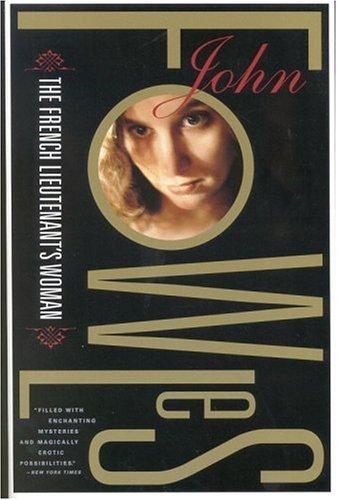
The French Lieutenant's Woman
John Fowles · 1926–2005 · England
Why it matters
A Victorian love affair unfolds while its narrator repeatedly steps forward to argue about how the story should end, and offers the reader two. A postmodern romance wearing perfect period costume.
At a glance
Victorian pastiche interrupted by an intrusive, argumentative postmodern narrator.
Deep dive
The narrator interrupts his own Victorian romance to argue with the reader about which ending it deserves — and then gives you two.
Written for readers who have finished the book. No plot recap, and nothing here is safe to read first.
Themes & symbolism
Sarah Woodruff's self-invented reputation as 'the French Lieutenant's Whore,' a scandal she does nothing to correct and may have partly fabricated, is the novel's central existentialist gesture: in a society that offers women almost no route to self-authorship, Sarah claims one anyway, by choosing a stigma over the alternative erasure of respectable invisibility, and Fowles frames her opacity — Charles, and the reader, never fully access her real motives — as the price of a freedom she refuses to explain or justify to anyone, including us.
Fowles's constant narratorial intrusions — essayistic digressions on Darwin, Marx, and Victorian sexual hypocrisy, a narrator who appears as a character in his own train compartment, a coin flip performed on the page to decide which ending gets told last — aren't postmodern showmanship for its own sake; they enact the novel's actual argument, that a nineteenth-century plot about a woman's 'ruin' can't be told straight anymore without confessing the modern author's power over her fate, and that confessing it is more honest than pretending the story simply unfolds on its own.
Charles Smithson's engagement to the conventional, pleasant Ernestina and his obsession with the unreadable Sarah restages Darwin (whom Charles reads and reveres as an amateur paleontologist) as sexual and social selection: Ernestina represents safe, well-adapted survival within Victorian convention, Sarah represents a genuinely unpredictable evolutionary leap, and Charles's choice between them is the novel's version of the same open-ended, non-teleological process Darwin had just described for species — no guaranteed happy adaptation, just consequences.
Three Endings, One Argument
Fowles gives the novel a brief, deliberately unsatisfying 'conventional' Victorian ending early — Charles marries Ernestina, Sarah vanishes, life continues placidly — before openly discarding it as the kind of lie the genre usually settles for, and staging two more substantial alternatives as equally 'real' outcomes, with his narrator flipping a coin on the page to decide which one to narrate last (and therefore, structurally, as the more privileged version). The device isn't a gimmick so much as Fowles's thesis stated as form: a genuinely modern novel can't pretend to the false certainty of Victorian closure, so instead of choosing one true ending, it makes the reader watch the mechanism of choosing itself.
The last seal: what actually happens, and why it lands the way it does.
The ending, explained
In the first substantial ending, Charles finds Sarah years later living independently among artists in Chelsea, reunites with her, and learns she's borne his child; the two are reconciled in something close to conventional romantic resolution. Fowles then rewinds the scene and replays it harsher: Charles finds Sarah in the same rooms, but she refuses to fully explain her years of silence or promise him anything, and he leaves alone, devastated but recognizably freer than he was as Ernestina's fiancé — forced, by Sarah's refusal to resolve into either villainess or prize, into a self-determining modern individual rather than a Victorian type. Fowles's narrator openly favors this second, unresolved version as truer, since Sarah's whole function has been to resist exactly the closure — marriage, explanation, a stable identity — the first ending quietly restores; leaving her unexplained is the novel's way of refusing to do to her, one last time, what Victorian society already did.