
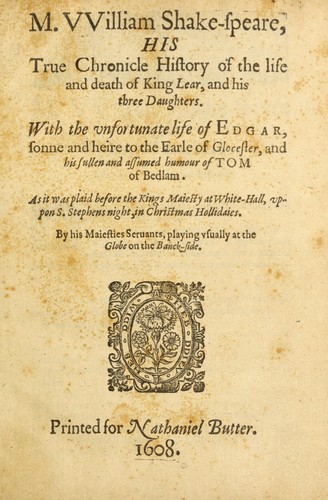
King Lear
William Shakespeare · 1564–1616 · England
Why it matters
An old king divides his kingdom by demanding declarations of love, banishes the one daughter who won't flatter, and is stripped of everything on a storm-lashed heath. Shakespeare's bleakest tragedy: family, power, and sanity dismantled together.
At a glance
Knotted late-Shakespeare syntax, a double plot, and madness rendered as fractured language.
Deep dive
Why the play refuses every chance to correct its opening injustice, and what that refusal says about the moral universe it takes place in.
Written for readers who have finished the book. No plot recap, and nothing here is safe to read first.
Themes & symbolism
The love test that opens the play is a category error Lear never quite recognizes as one: he asks for a public performance of love and receives exactly that from Goneril and Regan, then punishes Cordelia for refusing to convert something real into rhetoric on command. The Gloucester subplot mirrors this precisely — Gloucester is fooled by Edmund's forged letter into misreading his loyal son Edgar as a threat, exactly as Lear misreads his loyal daughter as insufficiently loving — and the doubling makes clear the play isn't diagnosing one foolish old man but a shared, structural failure to distinguish sincerity from its performance, wherever power creates an incentive to flatter.
Lear's madness on the heath is the play's most radical move: stripped of retinue, title, and shelter, he doesn't simply suffer, he starts noticing things kingship had always let him ignore — the exposure of the destitute, the arbitrariness of rank, his own responsibility for what's happened to him — and the Fool's riddling commentary and Edgar's disguise as the mad beggar Poor Tom surround him with performances of powerlessness that turn out more honest than anything said in the opening court scene. None of that hard-won clarity is rewarded; the play withholds the kind of external restoration that closes Hamlet, and Gloucester's blinding in particular is staged with a cruelty that refuses to let the audience read any clear moral order operating behind events.
The arithmetic of nothing
Lear warns Cordelia that her refusal to flatter him will cost her everything, treating love as a transaction where silence yields no return — and the play spends the rest of its length proving him right in ways he never intended. The more each character is stripped of title, land, sight, or retinue, the closer the play gets to whatever's actually true about them: Edgar's disguise reduces a nobleman to nothing, and Lear's own description of unaccommodated man on the heath, no more than a bare creature exposed to the elements like any other animal, arrives precisely at that zero point where he starts to see clearly for the first time. The play's bleakness and its insight are the same mechanism — everything has to be subtracted before anything real becomes visible, and by the time that visibility arrives, there's no longer enough left of the kingdom, or the people in it, to act on what's been learned.
The last seal: what actually happens, and why it lands the way it does.
The ending, explained
Cordelia returns with a French army to restore Lear, and their reconciliation, after everything that's happened, is the play's one moment of something like grace, which makes what follows harder rather than easier to take: their forces lose to Edmund's, they're imprisoned, and Edmund secretly orders Cordelia's execution before he's mortally wounded by Edgar and moved to revoke it. The order arrives too late. Lear enters carrying Cordelia's body, unable to fully accept she's gone, and dies moments later, apparently of grief, still uncertain in his last words whether she might somehow be breathing. Goneril and Regan have already destroyed each other over Edmund's affections in the meantime, so the play ends with almost an entire generation of the ruling family dead and only Edgar and Kent left standing, neither transformed nor rewarded so much as simply still there. Unlike Hamlet's Fortinbras, no outside order arrives to make sense of the wreckage — the play's refusal to supply that comfort is the whole point.
Where to go next
 William Shakespeare · 1593Richard IIILvl 6Fast paced
 William Shakespeare · 1595Romeo and JulietLvl 4Fast paced
 William Shakespeare · 1596A Midsummer Night's DreamLvl 3Fast paced
 William Shakespeare · 1601HamletLvl 6Medium pace
 William Shakespeare · 1602Twelfth NightLvl 4Fast paced
 William Shakespeare · 1603OthelloLvl 6Fast paced