
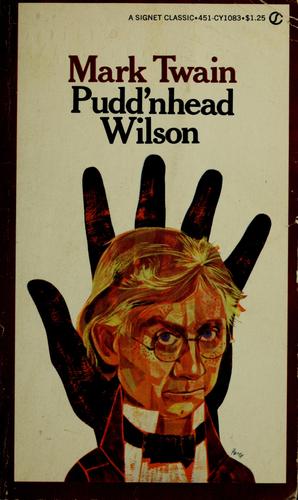
Pudd'nhead Wilson
Mark Twain · 1835–1910 · USA
Why it matters
A slave and her master's son, switched in the cradle, grow up into each other's lives in antebellum Missouri, until a small-town lawyer's fingerprint hobby unravels everything. Twain's bitterest late satire indicts slavery through farce that turns to courtroom tragedy.
At a glance
A tonal swerve from broad comedy to grim racial tragedy complicates an otherwise brisk plot.
Deep dive
An enslaved woman secretly trades her own baby's place in the nursery to spare him a future sold down the river, and a small-town lawyer's odd hobby of fingerprint collecting becomes the only thing capable of undoing the swap, decades later, in open court.
Written for readers who have finished the book. No plot recap, and nothing here is safe to read first.
Themes & symbolism
Roxana, enslaved and, by the era's one-drop accounting, one-sixteenth Black though indistinguishable in appearance from any white resident of Dawson's Landing, switches her infant son with her master's baby in their shared cradle, reasoning that raising her own child as the white heir is the only real protection she can give him. Twain sets the swap up almost as a fable's premise and then refuses to let it resolve like one: neither boy, the one raised as Tom Driscoll nor the one raised enslaved as Chambers, is improved or ennobled by the accident of which nursery he happened to grow up in.
Tom grows into a cruel, gambling-ruined young man who eventually murders his own uncle, Judge Driscoll, and Twain uses him to make a blunt argument: slavery's racial hierarchy is manufactured entirely by upbringing and social position rather than blood, since the boy the town calls white behaves worse than any of the enslaved men it condescends to. Meanwhile David Wilson, a lawyer the town nicknamed Pudd'nhead decades earlier over one misunderstood joke, has spent twenty quiet years as the local eccentric, cataloguing fingerprints as a hobby nobody else takes seriously.
Wilson's Calendar as the Novel's Real Narrator
Each chapter opens with a bitter epigraph attributed to Pudd'nhead Wilson's own private calendar of aphorisms, one-line jokes about human folly that comment obliquely on the action to come, and much of the novel's harshest irony lives in these fragments rather than in the plot itself, a running commentary from the one character sharp enough to see everyone else clearly and detached enough not to say so directly. Twain wrote the calendar entries as a separate, ongoing joke before the novel's plot was even settled, and the finished book keeps that separateness visible, Wilson's private wit running alongside a town too provincial to have ever taken him seriously.
The last seal: what actually happens, and why it lands the way it does.
The ending, explained
Defending two visiting Italian twins wrongly accused of Judge Driscoll's murder, Wilson breaks the case in open court by presenting fingerprint evidence identifying Tom as the actual killer, and in the same courtroom scene exposes the decades-old cradle switch: Tom is revealed as Roxana's biological son and immediately reclassified, under Missouri law, as property, sold down the river to settle the dead judge's estate despite having been raised his whole life as white gentry. Chambers, the town's actual white heir, is restored to a status and fortune he has no preparation for, uneducated, speaking in the only dialect he's ever known, unable to occupy the class he's suddenly handed. Twain grants neither man a happy resolution, since the law's fixation on blood over upbringing punishes both for a choice Roxana made in desperation and neither of them ever knew about, leaving the fingerprint-obsessed town fool as the only person in Dawson's Landing who ever looked at the actual evidence instead of at skin.
Where to go next
 Mark Twain · 1876The Adventures of Tom SawyerLvl 3Fast paced
 Mark Twain · 1881The Prince and the PauperLvl 3Fast paced
 Mark Twain · 1883Life on the MississippiLvl 4Medium pace
 Mark Twain · 1884Adventures of Huckleberry FinnLvl 5Fast paced
 Mark Twain · 1889A Connecticut Yankee in King Arthur's CourtLvl 5Fast paced
 Charles Dickens · 1861Great ExpectationsLvl 4Medium pace