
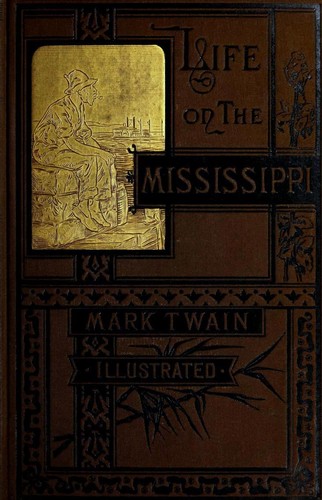
Life on the Mississippi
Mark Twain · 1835–1910 · USA
Why it matters
Twain's own apprenticeship as a steamboat pilot, followed decades later by a changed river he barely recognizes. Memoir and travelogue braided into an elegy for a vanished American trade and the boy who mastered it.
At a glance
Anecdotal, digressive nonfiction structure rather than a driving plot.
Deep dive
How Twain's own account of learning to read a river as a teenage steamboat pilot turns, decades later, into an elegy for a trade the railroads had already finished off by the time he came back to look at it.
Written for readers who have finished the book. No plot recap, and nothing here is safe to read first.
Themes & symbolism
The book's first half, adapted from Twain's earlier magazine series Old Times on the Mississippi, narrates his apprenticeship under the pilot Horace Bixby, who drills into him that piloting means holding the entire shifting geography of a two-thousand-mile river in memory at once, every snag, sandbar, and bend, in daylight and pitch dark alike, since one misread stretch of water can wreck a boat and everyone on it. Twain frames the training as its own demanding literacy, a way of reading a surface that every passenger on his boats crosses without ever learning to see as text.
Returning to the river after a fifteen-year absence and a changed career, now a famous writer rather than a working pilot, Twain finds the trade he mastered nearly extinguished by the railroads, and the second half's travelogue draws most of its real charge from that displacement: a man revisiting the one skill that once defined him and finding it obsolete. He turns some of the resulting irritation outward, arguing at length and with real anger that Walter Scott's romances helped manufacture the chivalric self-image that talked the South into a war it had no other good reason to fight.
Blaming Walter Scott for the Civil War
Twain's digression on Scott is only half a joke: he argues that Scott's novels, wildly popular across the antebellum South, supplied the region with an entire vocabulary of knightly honor and romantic feudalism it then applied, with disastrous literalism, to its own defense of slavery and secession, a claim that treats fiction not as harmless entertainment but as an active cause with a body count.
Bixby's Lesson: A River Read Twice a Day
The apprenticeship chapters insist that the Mississippi never stops changing shape, so that a pilot's hard-won knowledge of it is never finished knowledge but a discipline renewed every single trip, and Twain lets that lesson stand, unstated, as a rebuke to the tourist's version of the river he supplies in the book's second half, a landscape he can now only look at rather than truly read.
Where to go next
 Mark Twain · 1876The Adventures of Tom SawyerLvl 3Fast paced
 Mark Twain · 1881The Prince and the PauperLvl 3Fast paced
 Mark Twain · 1884Adventures of Huckleberry FinnLvl 5Fast paced
 Mark Twain · 1889A Connecticut Yankee in King Arthur's CourtLvl 5Fast paced
 Mark Twain · 1894Pudd'nhead WilsonLvl 5Fast paced
 Charles Dickens · 1861Great ExpectationsLvl 4Medium pace