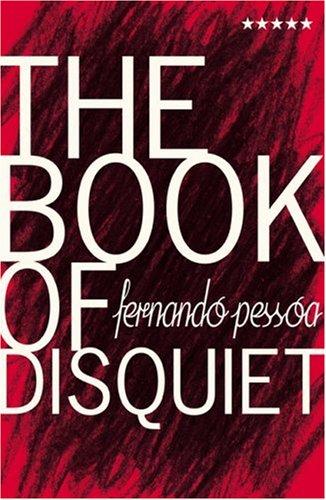
The Book of Disquiet
Fernando Pessoa · 1888–1935 · Portugal
Originally Livro do Desassossego (Portuguese)
Why it matters
The fragmentary diary of Bernardo Soares, a Lisbon bookkeeper who lives entirely in reverie. Assembled from a trunk of papers decades after Pessoa's death, it is the ultimate modernist notebook of a self that refuses to cohere.
At a glance
Plotless, aphoristic fragments meant for slow, meditative dipping rather than a read-through.
Deep dive
A Lisbon bookkeeper who barely leaves his office produces the strangest autobiography of the twentieth century, and its author didn't live to decide what order it went in.
Written for readers who have finished the book. No plot recap, and nothing here is safe to read first.
Themes & symbolism
Bernardo Soares's fragments return obsessively to tedium, not as an absence of feeling but as its own fully inhabited aesthetic condition — the tram ride, the office window, the sound of rain on Lisbon's Rua dos Douradores are described with an intensity most novels reserve for climactic events, because Soares's entire philosophy is that the interior life of noticing and dreaming is more real, and more worth attending to, than any of the external actions a conventional protagonist would be expected to take; the book's plotlessness isn't a lack, it's the argument.
Soares's recurring insistence that he prefers dreaming a thing to doing it, that imagined sensation is often richer than lived sensation, and that ordinary bourgeois existence (marriage, ambition, travel) would only diminish the vast interior world available to a man who simply stays at his ledger and watches, positions the book as a sustained defense of passivity as a legitimate, even superior, way of inhabiting a life — a position that reads, depending on the fragment, as either profound spiritual discipline or a beautifully articulated form of paralysis, and Pessoa never resolves which.
The prose itself performs the book's philosophy: aphoristic, self-canceling, frequently contradicting fragments written years apart and never reconciled, because Soares's selfhood is explicitly presented as something that doesn't cohere into a single stable position — 'I've made myself into the character of a book, a life one reads,' one fragment states directly — and the reader's experience of not being able to assemble a consistent Soares out of five hundred-odd pieces isn't a failure of the text, it's the most accurate possible rendering of what Pessoa believed a self actually is.
A Book Assembled After Death
Pessoa left the fragments that make up this book, along with a note or two toward organizing them, unpublished and largely unordered in a trunk at his death in 1935; no version of The Book of Disquiet reached print in any form until 1982, forty-seven years later, when Portuguese scholars first assembled and published the surviving fragments as a single volume. Every edition since, including the various English translations that have appeared with different fragment selections and orderings, is necessarily an editorial reconstruction rather than a text Pessoa ever finalized or approved — which means there is no single canonical Book of Disquiet, only a set of competing, defensible arrangements of the same underlying material, a situation unusually appropriate to a book about a self that never resolves into one fixed shape either.
Bernardo Soares, the 'Semi-Heteronym'
Pessoa wrote under dozens of invented authorial personas he called heteronyms — Alberto Caeiro, Ricardo Reis, Álvaro de Campos among the major ones — each with a distinct biography, style, and worldview, functioning as genuinely separate literary identities rather than mere pseudonyms. Soares occupies a stranger middle position Pessoa himself termed a 'semi-heteronym': not a fully independent invented personality like the others, but, in Pessoa's own description, 'a mutilation' of his own identity, sharing his employer, his neighborhood, and much of his actual temperament while still existing as someone distinct enough to author a book Pessoa himself apparently couldn't write directly. That ambiguous distance — neither Pessoa's diary nor a wholly separate character's novel — is precisely what gives the fragments their peculiar, unplaceable intimacy.