
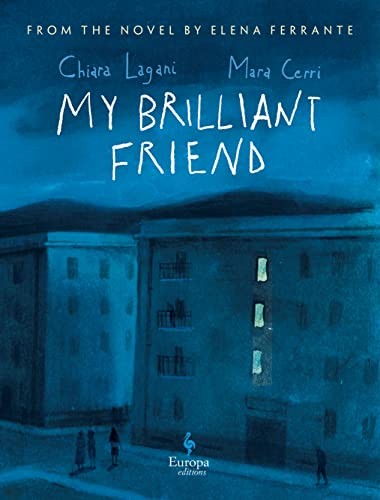
My Brilliant Friend
Elena Ferrante · b. 1943 · Italy
Originally L'amica geniale (Italian) · translated by Ann Goldstein
Why it matters
Lila and Lenù, one poor Naples neighborhood, and the ferocious arithmetic of female friendship: the opening of the Neapolitan Quartet, the century's great word-of-mouth epic. Narrative force critics had declared old-fashioned, vindicated overwhelmingly.
At a glance
Direct, propulsive prose; difficulty lies in tracking a large recurring cast.
Deep dive
Whose brilliance the title actually names, why Lenù's admiration is inseparable from envy, and what those wedding-day shoes are really telling you.
Written for readers who have finished the book. No plot recap, and nothing here is safe to read first.
Themes & symbolism
Ferrante frames Lila and Lenù's friendship less as tenderness than as a competitive economy of attention and intelligence, where being truly loved by the other means being truly seen — and being truly seen is dangerous, because Lila's brilliance is bigger, faster, less patient than Lenù's, and Lenù's whole narration is an attempt to catch up to a girl she was never educated the same as. The novel's central injustice is procedural rather than dramatic: Lila is pulled from school not because she's less gifted but because her family can't or won't pay, while Lenù's more modest and effortful intelligence gets rewarded with the one resource — continued schooling — that could have changed Lila's life. Ferrante refuses to let this read as simple bad luck; it's the neighborhood's whole economy of gender and money working exactly as designed.
Lila's response to being shut out of formal education — teaching herself Latin and Greek, designing shoes with Rino — is presented as proof that her intelligence needed no institution to express itself, which makes the marriage plot that closes the book so devastating. Marrying Stefano is, on its own terms, a rational and even canny move: he has money, a gentler reputation than the Solaras, and, she believes, willingness to bankroll the shoe business. Ferrante treats the neighborhood's violence, embodied above all in the Solara brothers, as inescapable weather rather than backdrop — every character's choices, however individually reasoned, are made inside a system the Solaras already own.
Naples itself functions almost as a character in its own right — the courtyard, the shoe shop, the loan-shark's ledger, the casual threat of violence that punctuates ordinary transactions. Ferrante's prose stays plain and unadorned even when describing the neighborhood's ugliest moments, refusing melodrama in a way that makes the violence feel structural rather than exceptional, the water everyone in the story swims in rather than a plot device visited on them.
Lenù as an Unreliable Narrator of Her Own Admiration
Lenù narrates the entire Neapolitan Quartet decades later, and part of what makes My Brilliant Friend unsettling on a second read is how much of what we know about Lila comes filtered through a narrator who has spent her whole life measuring herself against her friend. Lenù's affection for Lila is inseparable from envy, and her account of Lila's genius is also, always, a way of explaining her own perceived second-place finish — smarter people worked harder to notice Lila; Lenù just noticed. Ferrante never lets the reader forget that "brilliant friend" cuts two ways depending on who's speaking; the title's referent is genuinely ambiguous, and even at the end of this volume it isn't settled.
The last seal: what actually happens, and why it lands the way it does.
The ending, explained
At Lila's wedding to Stefano — a marriage she has engineered as her one available route out of poverty and into some control over her own life — she spots him wearing a pair of the shoes she designed with Rino specifically to fund the family's independence. The shoes have been handed, without her knowledge, to Marcello Solara: proof that Stefano has aligned himself, financially or otherwise, with the very family Lila most needed her marriage to defeat. Lenù registers the moment entirely from outside, watching Lila's face change in real time at her own reception. The volume ends there, mid-recognition, denying Lila even the space for a reaction — a fittingly abrupt close to a book about how little control either woman actually has over the terms of her own story.
Where to go next
 Elena Ferrante · 2002The Days of AbandonmentLvl 4Fast paced
 Elena Ferrante · 2012The Story of a New NameLvl 3Fast pacedElena Ferrante · 2013Those Who Leave and Those Who StayLvl 4Fast pacedElena Ferrante · 2014The Story of the Lost ChildLvl 4Fast paced
 Antonio Tabucchi · 1994Pereira MaintainsLvl 4Medium pace
 Jeffrey Eugenides · 2002MiddlesexLvl 6Medium pace