
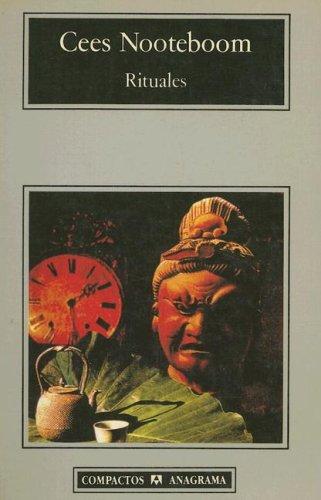
Rituals
Cees Nooteboom · b. 1933 · Netherlands
Originally Rituelen (Dutch)
Why it matters
A wealthy, drifting Amsterdam man's life is bracketed by two eccentric mentors, each devoted to a private system of ceremony. Nooteboom's cool, essayistic study of modern rootlessness and the need for form.
At a glance
Cool, essayistic prose built around private systems of meaning.
Deep dive
What a man who collects enthusiasms rather than convictions learns from standing between two men who each built a discipline extreme enough to swallow a life whole.
Written for readers who have finished the book. No plot recap, and nothing here is safe to read first.
Themes & symbolism
Inni Wintrop deals in art, women, and passing enthusiasms, never landing on any of them long enough to be changed by them, and Nooteboom builds his whole method as a foil against the two Taadses: form without content, tried on and shed like the overcoats Inni is always losing. His own halfhearted attempt on his life early in the book, an experiment he survives more from carelessness than resolve, sets the register: everything Inni does, even that, he does provisionally.
Arnold Taads answers formlessness with total discipline, subdividing his mountain days into minutes he refuses to spend on anyone, worshipping the clock precisely because he distrusts what time does to a life left unstructured. Philip, the son he never met and barely resembles in temperament, finds the same absolutism inside the Japanese tea ceremony, a system so total it doesn't need a person's history to fill it, only the correct gesture repeated correctly, generation after anonymous generation. Neither man's discipline is presented as healthier than Inni's drift, which is what keeps the novel from turning into a simple morality tale about commitment: total systems and no system at all both, in Nooteboom's arrangement, end up costing exactly what they promise to organize.
The Bowl That Outranks the People Who Touch It
The raku tea bowl Philip venerates, centuries old and deliberately imperfect by design, is the novel's clearest object lesson: a ritual object whose value depends entirely on the exactness of the practice around it, not on any story it could tell about its owners. Inni, a dealer in art whose value he can only ever price, is constitutionally unable to understand an object valued this way, and the gap between his connoisseurship and Philip's devotion is the real distance the novel measures.
Amsterdam Across Three Decades of the Same Afternoon
Nooteboom sets his three movements a decade apart, 1963, a flashback to 1953, then 1973, without ever letting Inni age into wisdom; the city changes around him, but his own capacity for total commitment doesn't. That refusal to grant its protagonist a character arc is the novel's quiet argument: some people are built to survey rituals, never to be saved by one.
The last seal: what actually happens, and why it lands the way it does.
The ending, explained
Arnold's isolation ends when his dog is killed and, within days, so does he, a suicide the novel records with the same flat notation it gives his stopwatch habits, forgotten by everyone in the book except Inni. Philip, twenty years on, walks away from the physical world he has always found oppressive, following the tea ceremony's discipline to its logical vanishing point rather than surviving it the way Inni survives his own halfhearted attempt at exit. The novel's last image is Inni's own invention: father and son meeting at last in an imagined afterlife neither reached in life, arguing forever over whose ritual was purer, a fantasy only the dabbler left alive is equipped to picture, since he's the only one of the three who never had to choose.
Where to go next
 Harry Mulisch · 1992The Discovery of HeavenLvl 6Medium pace
 Paul Harding · 2009TinkersLvl 6Slow burn
 Hugo Claus · 1983The Sorrow of BelgiumLvl 6Medium pace
 Peter Handke · 1972A Sorrow Beyond DreamsLvl 6Slow burn
 André Gide · 1902The ImmoralistLvl 5Medium pace
 Iris Murdoch · 1978The Sea, the SeaLvl 6Slow burn