
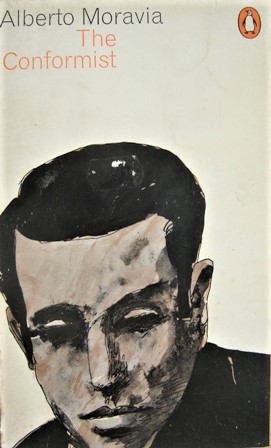
The Conformist
Alberto Moravia · 1907–1990 · Italy
Originally Il conformista (Italian)
Why it matters
A man so desperate to be normal that he becomes a Fascist assassin, mistaking conformity for a cure. Moravia's cold anatomy of the ordinary evil that lets regimes function.
At a glance
Interior psychological analysis of a bureaucratic killer, dense but linear.
Deep dive
A man commits murder in service of a Fascist regime mainly to finally feel like everyone else — and Moravia spends the whole novel asking whether a life built entirely around 'normality' can survive contact with an actual choice.
Written for readers who have finished the book. No plot recap, and nothing here is safe to read first.
Themes & symbolism
Marcello Clerici's lifelong project of 'normality' is rooted, Moravia makes clear, in a childhood trauma he's never processed: as a boy he believed he killed the chauffeur Lino after Lino's attempted sexual assault on him, and from that point on Marcello organizes his entire adult identity around becoming as unremarkable, conventional, and legible to others as possible — marrying a shallow, conventionally pretty bourgeois fiancée, Giulia, precisely for her ordinariness, and joining the Fascist secret police not out of ideological conviction but because Fascism offers the most totalizing, uniform-wearing, rule-following version of belonging available to a man desperate to disappear into the crowd.
The mission Marcello accepts — to facilitate, under cover of his honeymoon, the assassination of his former university professor Quadri, now an anti-Fascist exile in Paris — puts his need for conformity into direct, excruciating contact with the one relationship in the novel that actually tempts him toward a different life: his attraction to Quadri's wife Lina (who in turn desires Giulia) exposes desires and identifications Marcello has spent his whole life suppressing in the name of normalcy, and Moravia stages the Paris sequence as the closest Marcello ever comes to admitting that his entire adult self is a performance built over an abyss he can't look into directly.
Moravia's cold, clinical prose style, closely tracking Marcello's own self-justifying rationalizations without ever fully endorsing them, is the novel's mechanism for its larger political argument: Fascism, in this account, isn't chiefly the work of true believers or sadists but of ordinary, conflict-averse men willing to do almost anything to avoid standing out, feel abnormal, or be identified as different — a diagnosis of totalitarian complicity as a problem of psychology and desperate belonging rather than simply of ideology.
The Novel Behind Bertolucci's Film
Bernardo Bertolucci's celebrated 1970 film adaptation is visually and structurally freer than Moravia's novel — restructuring the chronology, adding the famous Plato's-cave dialogue with Quadri and reworking Marcello's psychology through a more overtly Freudian, visually symbolic lens — and while the film has become for many readers the more familiar version of the story, it also changes or omits some of the novel's specific late-book turns, including the fuller working-out of what happens to Marcello afterward. Moravia's own prose, tighter and more interior than the film's operatic visual style, keeps the emphasis squarely on Marcello's self-deceiving internal logic rather than on the political spectacle Bertolucci foregrounds, which is worth reading directly rather than assuming the film has already told the whole story.
The last seal: what actually happens, and why it lands the way it does.
The ending, explained
The assassination of Quadri and Lina goes forward in the Savoy forest despite Marcello's last-minute hesitation; he watches, passive and complicit, as the agents run the couple's car off the road, an act that finally gives him the direct blood-guilt his life has been organized to avoid, layered over the false guilt about Lino he's carried since boyhood. Years later, the night Mussolini's regime collapses in 1943, Marcello encounters by chance a man he recognizes as Lino, very much alive: the chauffeur never died at all, meaning the foundational trauma that justified an entire adult life of conformist self-erasure, culminating in a real political murder, was built on violence that never happened. Moravia denies Marcello even a coherent tragic arc; caught in the chaotic street violence of the regime's collapse, he and his family are killed almost incidentally — a death as arbitrary as the mistaken killing he spent his life atoning for.
Where to go next
 Alberto Moravia · 1947The Woman of RomeLvl 4Medium pace
 Antonio Tabucchi · 1994Pereira MaintainsLvl 4Medium pace
 Italo Svevo · 1923Zeno's ConscienceLvl 6Medium pace
 Cesare Pavese · 1950The Moon and the BonfiresLvl 6Slow burn
 Luigi Pirandello · 1904The Late Mattia PascalLvl 5Medium pace
 Gabriele D'Annunzio · 1889The Child of PleasureLvl 6Slow burn