
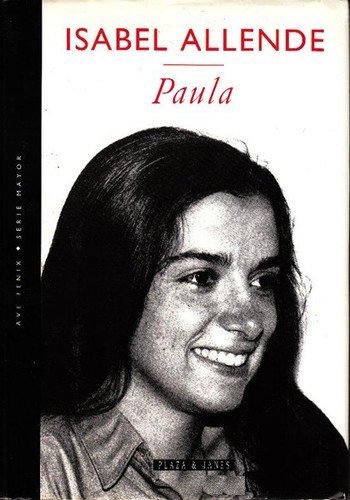
Paula
Isabel Allende · b. 1942 · Chile
Originally Paula (Spanish) · translated by Margaret Sayers Peden
Why it matters
Written at her dying daughter's bedside, Allende's memoir unspools her own turbulent family history and exile as a letter meant to be heard, if only Paula could wake to hear it. Grief transmuted directly into her most personal book.
At a glance
Warm, direct memoir prose, though the braided grief and family chronicle reward patience.
Deep dive
Isabel Allende begins writing to her comatose daughter as a way of filling the silence at her bedside, and what starts as a letter turns into the fullest account she's ever given of her own family, her country, and the stories that made her a writer in the first place.
Written for readers who have finished the book. No plot recap, and nothing here is safe to read first.
Themes & symbolism
Allende began this memoir at the hospital bedside of her daughter Paula, who fell into a coma from a rare metabolic disorder, porphyria, in Madrid in 1991 and never regained consciousness, and the book alternates between two kinds of writing: an unfolding present-tense account of the vigil itself, and long retrospective chapters recounting Allende's own life, her family's history in Chile, her uncle Salvador Allende's presidency and the 1973 coup that ended it, her subsequent exile, and the personal material that had already fed her novels. The dual structure makes the book's method explicit: Allende writes her own past for Paula partly to have something to say into an unresponsive silence, and partly because a daughter in a coma cannot yet be mourned as gone, only addressed as if she might still, somehow, be listening.
Family memory, in Allende's telling, functions as both inheritance and survival strategy, the same magical, digressive storytelling that shapes her fiction here doing the harder work of holding a family together through dictatorship, exile, and now a medical catastrophe with no cure. The memoir doesn't distinguish sharply between the fantastical elements of her family's oral history, ghosts, premonitions, inherited destinies, and the documented political history running alongside them, since for Allende both registers are simply how her family has always made sense of what happens to it.
Allende is candid about how much her own fiction, most directly The House of the Spirits, had already been drawn from these same relatives and events, and Paula functions in part as a kind of key to that earlier work, naming the real grandmother, the real coup, the real exile behind stories she had previously reshaped into invented characters. Writing the unfiltered version for a daughter who can't respond forces a different kind of honesty than the novels allowed, since there's no plot to serve, only the accumulated fact of what her family actually survived, told with none of fiction's usual permission to soften or rearrange it.
Writing as a Vigil, Not a Retrospective
Unlike a conventional memoir composed after events have settled into a fixed shape, Paula was written in real time, its later chapters recording a crisis whose outcome Allende did not yet know as she wrote them, and that uncertainty gives the prose an urgency closer to a diary than a finished narrative. The book's structure, one long chapter of remembered family history for essentially every stretch of unchanged medical news at Paula's bedside, means readers experience Allende's accumulating grief and her accumulating self-knowledge on the same timeline she did, the memoir itself functioning as the vigil's only available action once medicine has nothing further to offer.
The last seal: what actually happens, and why it lands the way it does.
The ending, explained
Paula never wakes from her coma and dies in December 1992, roughly a year after falling ill, and Allende closes the book in the immediate aftermath of that loss rather than pulling back into more distanced reflection. The accumulated family history the memoir has been assembling all along, revolution, exile, generations of women surviving worse, becomes explicitly what Allende leans on to absorb a loss that has no larger political or historical meaning attached to it, simply a young woman's death from an untreatable illness. The book ends with Allende affirming that the act of writing it, addressed the whole time to a daughter who never read a word of it, was itself what let her keep living afterward.
Where to go next
 Isabel Allende · 1982The House of the SpiritsLvl 4Fast paced
 Isabel Allende · 1984Of Love and ShadowsLvl 4Medium pace
 Isabel Allende · 1987Eva LunaLvl 4Fast paced
 Isabel Allende · 1999Daughter of FortuneLvl 4Fast paced
 Gabriel García Márquez · 1967One Hundred Years of SolitudeLvl 6Medium pace
 Toni Morrison · 1987BelovedLvl 8Slow burn