
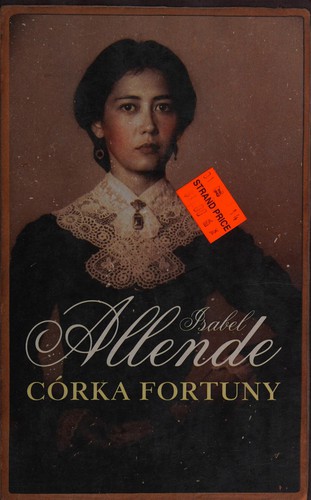
Daughter of Fortune
Isabel Allende · b. 1942 · Chile
Originally Hija de la fortuna (Spanish) · translated by Margaret Sayers Peden
Why it matters
An orphaned Chilean girl stows away to Gold Rush California chasing a vanished lover and remakes herself entirely along the way, aided by a Chinese doctor who becomes her truest companion. Allende's biggest canvas: self-invention against frontier chaos.
At a glance
A sweeping but linear adventure narrative told in Allende's characteristically warm, accessible prose.
Deep dive
A young woman raised in genteel Valparaíso stows away for California disguised as a boy to chase a man who's already gone, and the search gradually stops being about finding him at all.
Written for readers who have finished the book. No plot recap, and nothing here is safe to read first.
Themes & symbolism
Eliza Sommers, adopted as an infant by a British trading family in Valparaíso, falls for Joaquín Andieta, a clerk with revolutionary sympathies and ambitions of striking it rich in California's gold fields, and when he leaves without her, she stows away on a ship bound for San Francisco, disguised as a boy after miscarrying the child she was carrying during the crossing. Allende spends the first half of the novel building Eliza's proper, constrained upbringing in careful, almost suffocating detail specifically so the disguise and the journey that follow read as a genuine rupture rather than an adventure lightly undertaken, a woman using the one tool, invisibility as a boy, available to a woman with no other legal claim to independent movement.
Tao Chi'en, a Chinese physician Eliza meets aboard ship and who becomes her protector, translator between worlds, and eventual life partner, gives the novel its widest lens on the Gold Rush's actual population, immigrant labor from China alongside Chileans, Mexicans, and Americans all chasing the same rumor of quick wealth in a territory none of them controls. Allende uses his medical training and his own experience of dispossession, sold into indentured service as a boy in China, to counter the Gold Rush's usual mythology of self-made American opportunity with a much more crowded, exploited, and international picture of who actually built California's early economy.
A Search That Becomes Its Own Destination
Eliza spends most of the novel disguised, mobile, and searching, first for Joaquín, later simply for a life she can recognize as her own, and Allende structures that long middle section so the initial romantic motive quietly recedes without ever being formally abandoned. By the time real information about Joaquín's fate surfaces late in the book, Eliza has already built an identity, competence, and set of relationships that don't depend on finding him, and Allende lets that shift stand as the novel's actual argument, that the freedom Eliza gains chasing a man turns out to matter more, and last longer, than the man himself ever could have.
The last seal: what actually happens, and why it lands the way it does.
The ending, explained
Word reaches Eliza and Tao Chi'en of the death of Joaquín Murieta, a notorious bandit whose legend was already spreading through Gold Rush California, and the possibility that he and her lost Joaquín Andieta are the same man, whether the outlaw's exploits were driven by the same idealism that once sent Andieta chasing gold, hangs over the novel's final pages without ever being confirmed. Allende deliberately withholds a definitive answer, since Eliza's own arc no longer requires one: she chooses to stay with Tao Chi'en, whose steady companionship has become more real to her than the uncertain fate of a man she loved as a girl. The novel closes on that unresolved question standing in for its larger theme, that Eliza's fortune was never going to be a man found, but a self chosen freely instead of inherited.
Where to go next
 Isabel Allende · 1982The House of the SpiritsLvl 4Fast paced
 Isabel Allende · 1984Of Love and ShadowsLvl 4Medium pace
 Isabel Allende · 1987Eva LunaLvl 4Fast paced
 Isabel Allende · 1994PaulaLvl 4Medium pace
 Gabriel García Márquez · 1967One Hundred Years of SolitudeLvl 6Medium pace
 Toni Morrison · 1987BelovedLvl 8Slow burn